15 min read
Are Trade Fairs Still Worth It? A Strategic Look for Brands
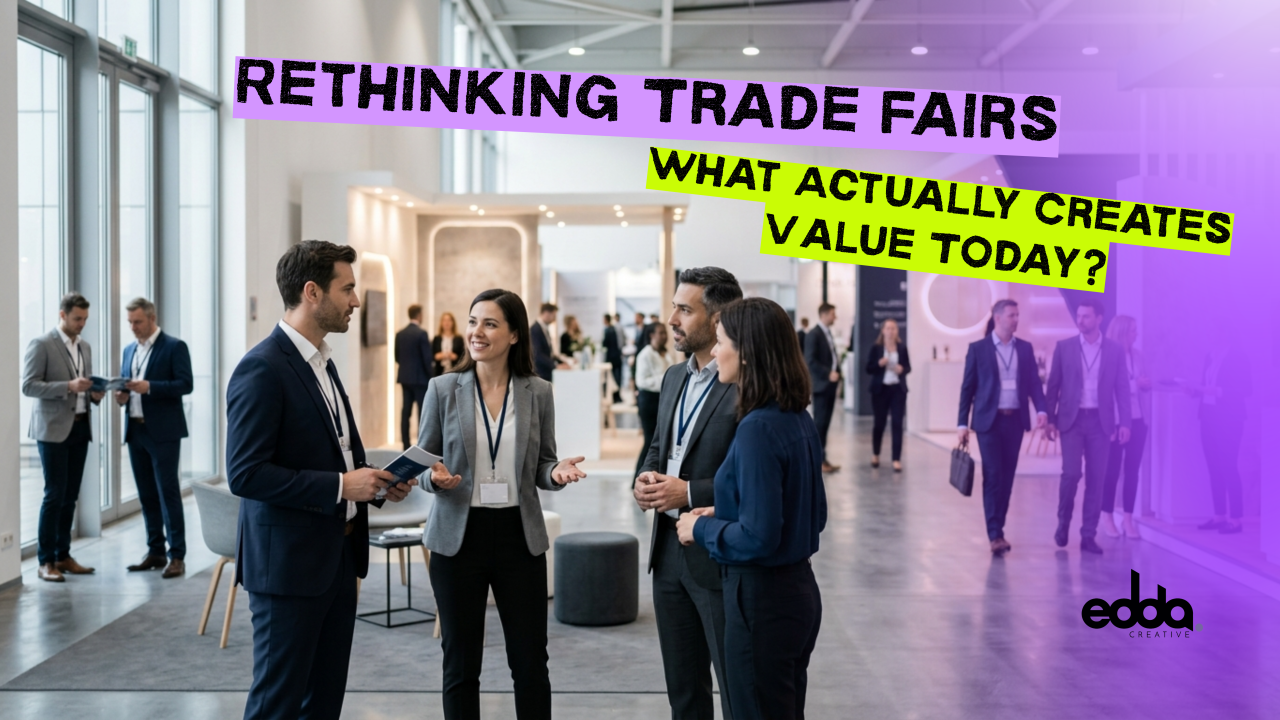
Rethinking Trade Fairs: What Actually Creates Value Today?
Trade fairs have long been a fixed item in marketing calendars. Budgets are allocated, stands are designed, teams are sent. Yet the outcomes are often uneven. Some brands return with concrete opportunities and clear next steps, while others leave with little more than visibility.
The difference rarely lies in the event itself. It lies in how deliberately the fair is used.
Today, trade fairs should not be seen as standalone activities, but as high density moments of market exposure , where positioning, perception and opportunity intersect in real time.
A Rare Advantage: Direct Market Visibility
In an increasingly digital environment, many interactions are filtered. Messages are curated, responses are delayed, and insights are often indirect. Trade fairs remove that layer.
They allow brands to:
- Observe how competitors present themselves not through campaigns, but in person
- Compare products, materials and quality standards side by side
- Understand pricing signals and value positioning more clearly
- See which narratives resonate with visitors and which do not
This makes fairs one of the few places where market reality is visible without interpretation . For brands, this is not only a sales opportunity. It is a chance to recalibrate how they are positioned within their category.
The Strategic Value of Being Physically Present
There is also a fundamental difference in how relationships begin at a fair. Unlike digital channels, where attention must be earned over time, fairs bring together people who are already open to interaction.
This creates:
- Faster entry into meaningful conversations
- Higher intent from both sides
- A more immediate sense of trust
In practical terms, a conversation that might take weeks to initiate online can happen within minutes in a physical setting. But this advantage is only meaningful if the brand is prepared to guide that interaction with clarity.
Choosing the Right Fair: A Matter of Alignment, Not Scale
Not every fair is equally valuable for every brand. The most effective choices are not based on size or reputation alone, but on alignment .
A well-chosen fair typically reflects:
- The brand’s current or target market
- The type of partners or clients it aims to reach
- The level of decision-making authority present among attendees
In many cases, smaller and more focused fairs provide stronger outcomes than large, general events. The environment is more relevant, conversations are more precise, and expectations are clearer.
For brands expanding into new regions, local fairs often offer deeper insight into market dynamics than global exhibitions.
What Visitors Actually Experience
Once inside a fair, visitors move quickly. Attention spans are short, and comparisons happen instantly. In this context, what matters most is not how impressive a stand looks, but how clearly a brand communicates.
Within seconds, a visitor intuitively evaluates:
- What the brand offers
- Whether it is relevant to their needs
- Whether it is worth engaging further
This is where many opportunities are lost. When messaging is unclear, interactions remain superficial, and the brand becomes interchangeable with others. Clarity, not complexity, is what creates traction.
Beyond Sales: Trade Fairs as Intelligence Platforms
One of the most underestimated aspects of trade fairs is their role as intelligence platforms . They provide immediate answers to questions that are otherwise difficult to validate:
- Which product features are gaining attention
- How competitors are evolving their positioning
- Where the market is becoming saturated
- Where new gaps are emerging
This information is rarely available in such a concentrated and observable form. Brands that actively observe and interpret these signals leave with more than contacts, they leave with direction .
Where the Real Value Is Often Lost
While much attention is given to preparation and presence, the most critical phase often receives the least focus: what happens after the fair. Contacts are collected, conversations are noted, but without structure, the momentum fades quickly.
Value is lost when:
- Interactions are not prioritized
- Follow-ups are delayed or generic
- Next steps are not clearly defined
A trade fair is not a closed event. It is the starting point of a process that needs continuity. When that continuity is missing, even strong initial engagement does not translate into outcomes.
A More Realistic Perspective
Trade fairs are neither outdated nor universally effective. They are highly situational. When approached without clarity, they become expensive and difficult to measure. When approached with intent, they can accelerate access, insight and relationships in ways few other channels can.
The difference lies in how deliberately the brand:
- Selects the environment
- Positions itself within it
- And carries the interaction forward
Trade fairs do not create value by default. They reveal how well a brand understands its market, its audience and itself. And when that understanding is clear, a few days at the right fair can shape months of direction ahead.