13 min read
The Art of Intelligent Scaling: Why Growth Hacking is a Mindset, Not a Tactic
In an era where digital noise is at an all time high, the rules of brand scaling are being radically rewritten. For decades, the traditional corporate playbook dictated that massive market share required equally massive capital injection. Today, we know that sustainable impact cannot simply be bought; it must be engineered.
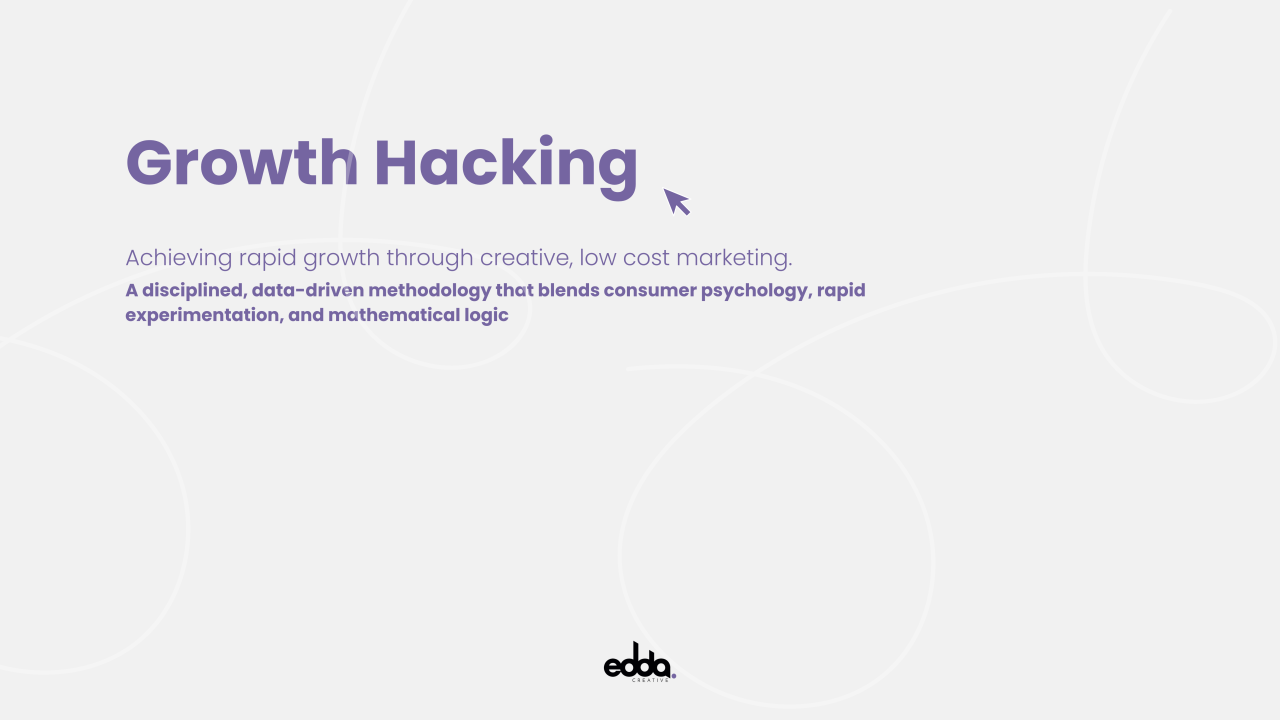
At Edda Creative, we operate on a core conviction: true sophistication lies in optimization. This is why we view Growth Hacking not merely as a collection of low cost marketing tricks or temporary shortcuts, but as a disciplined, high level discipline where rigorous data analytics meets creative cultural intelligence.
Moving Beyond the Buzzword
To understand growth at a professional level, one must look past the superficial definition of “quick fixes.” Real growth hacking is an iterative framework deeply rooted in the intersection of behavioral data, product design, and automation. It shifts the focus from spending money to understanding user incentives.
When we strip away the industry jargon, growth hacking is essentially the application of the scientific method to business expansion. Instead of launching a massive, unproven six month campaign and hoping for the best, it relies on rapid, micro experimentation. We form a hypothesis based on user friction, test it within days, analyze the data, and either scale it or discard it immediately.
Anatomy of an Elegant Growth Loop: Real World Paradigms
To understand how this operates in the real world, we can look at classic examples where clever engineering bypassed millions of dollars in advertising:
- The Airbnb Integration (API Reverse Engineering): In its infancy, Airbnb realized their target audience was already actively looking for alternative accommodations on Craigslist. Instead of buying expensive Google ads, they built a smooth technical integration that allowed hosts to cross post their listings to Craigslist with a single click. They didn’t build a new audience from scratch; they elegantly hijacked an existing ecosystem.
- The Dropbox Viral Loop (Productized Incentives): Rather than spending their limited budget on traditional customer acquisition, Dropbox integrated the marketing directly into the product. By offering 250MB of free extra storage to both the referrer and the referred, they turned their early adopters into an organic sales force. The product itself became the distribution channel.
- The Early Hotmail Signature (Passive Virality): One of the earliest and simplest growth hacks was Hotmail adding a default, subtle footer to every outbound email: “P.S. I love you. Get your free e-mail at Hotmail.” Every single user implicitly vouched for the brand simply by communicating. It cost zero dollars and resulted in exponential user acquisition within months.
The Technical Framework: Funnel Architecture
While conventional marketing frequently obsesses over the top of the funnel—driving broad, expensive brand awareness an intellectual growth strategy looks at the entire user journey. We analyze performance through a holistic architecture:
- High Intent Acquisition: Moving away from broad demographics to target micro-communities and behavioral triggers where the pain point is sharpest.
- The “Aha! Moment” (Activation): Engineering the shortest possible path for a new user to experience the core value of a service. If a user doesn’t experience delight within the first 60 seconds, the acquisition cost is entirely wasted.
- Cohort Retention Analysis: The true metric of sustainable growth. There is no point in filling a bucket that has a hole in the bottom. We meticulously study retention curves to ensure product-market fit before pouring fuel on the fire.
Our Vision: Efficiency is the Highest Form of Sophistication
Great budgets don’t change industries; well crafted, asymmetric ideas do. Burning through venture capital or corporate reserves to achieve artificial, short term spikes is a sign of strategic stagnation. True market leadership belongs to those who can observe raw, messy consumer behavior, extract a profound psychological insight, and execute a mathematically sound solution.
As we look toward the future of digital ecosystems, the seamless alignment of clean brand positioning and rigorous growth engineering will separate the legacy companies that fade from the modern brands that endure. Bypassing traditional constraints isn’t just a clever alternative anymore it is the modern standard for intellectual business strategy.
#GrowthHacking #DigitalStrategy #DataDrivenMarketing #EddaCreative #BrandIntelligence #LinkedInNewsletter #BusinessEngineering