5 min read
The truth stays the same, the viewpoint changes: where do your customers see your brand from?
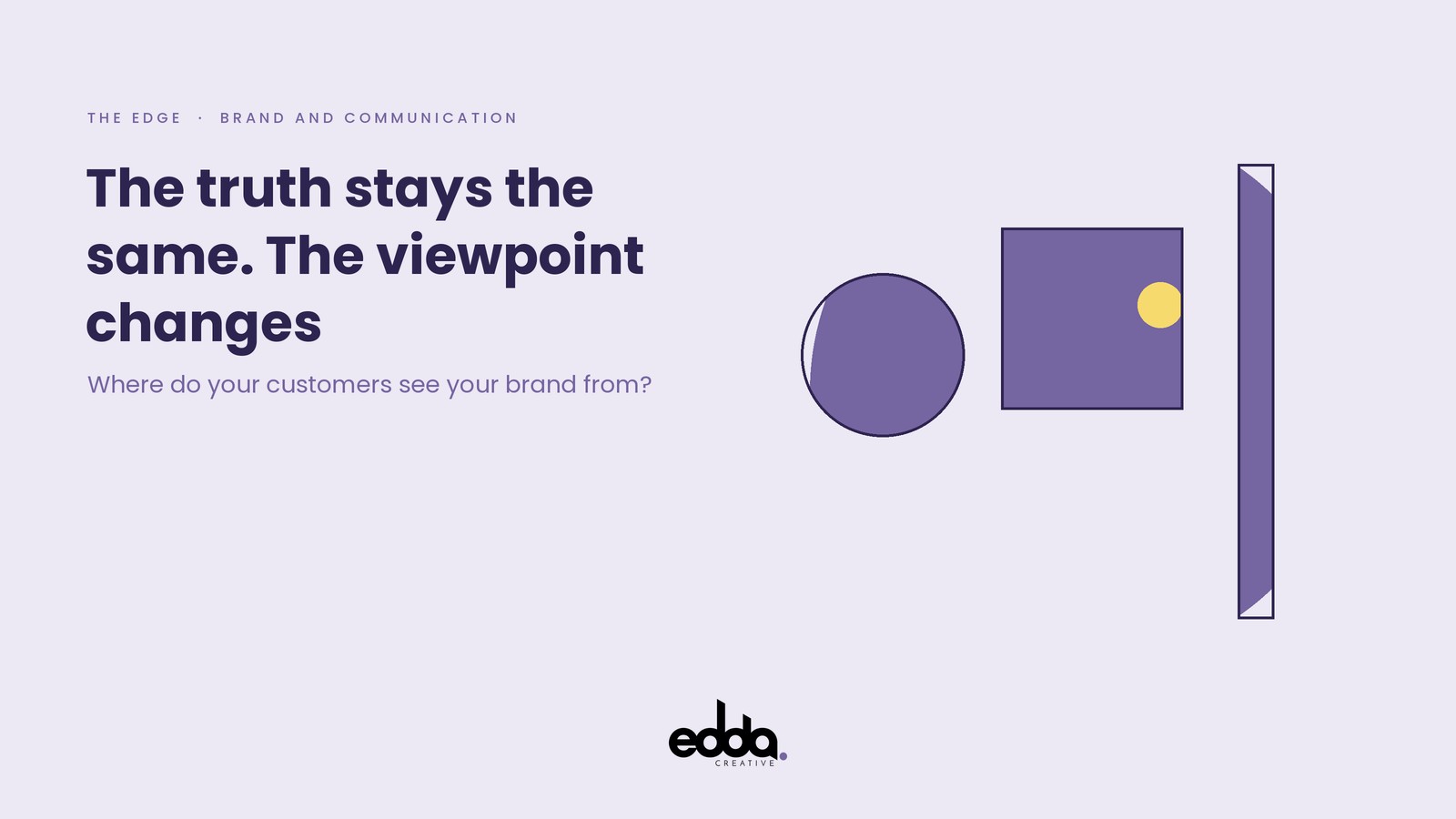
Look at a cylinder from above and you see a circle. Look at it from the side and you see a rectangle. Both are true, and both are the same object. The only thing that changes is where you stand. Brands work the same way: the brand a company sees from the inside and the brand its customers see are two views of the same reality. In this article we explain why that gap is so expensive in marketing, and how to close it.
In short
- Companies see themselves from the inside: technical detail, development history, internal language.
- Customers look from the outside: their own problem, their own risk, their own words.
- The curse of knowledge: people who know a subject well struggle to imagine how it looks to someone who does not. Research shows this in measurable terms.
- In B2B there is no single customer: engineering, procurement and management look at the same product from three different places.
- The fix: build the message from where the customer stands, not from the inside. That starts with listening.
The curse of knowledge: why nobody hears what we say
In 1990, Stanford psychology student Elizabeth Newton ran a simple experiment. One group tapped the rhythm of well-known songs on a table; another group tried to guess the songs. The tappers predicted that listeners would recognise half of them. In reality, listeners guessed only 3 of 120 songs.
The tappers heard the melody in their heads. The listeners heard only knocking. Same reality, two different places. Economists Colin Camerer, George Loewenstein and Martin Weber described this effect in 1989 as the “curse of knowledge”: the better informed person cannot accurately predict the perspective of someone who knows less.
In marketing this happens every day. The team that writes “integrated solution”, “end-to-end platform” or “high efficiency” on its website knows everything behind those words. A procurement manager opening the page for the first time only hears knocking.
One product, three different truths
B2B purchases rarely have a single decision maker. Say an industrial company is looking at a new energy storage system. The same system is seen:
- By the engineer through a technical lens: capacity, integration, maintenance, standards.
- By procurement through a risk and cost lens: total cost, lead time, supplier reliability, contract terms.
- By the managing director through a strategic lens: what will this bring the company, which risk does it reduce, how do I explain it to the board?
All three views are true. But a single brochure, LinkedIn post or presentation usually speaks to only one of them, often the engineer, because an engineer usually wrote it. The other two do not find what they need, and the decision slows down.
Culture is a viewpoint too
The same sentence reads differently in Ankara and in Amsterdam. “Our versatile team creates solutions for every need” sounds reassuring in Türkiye but vague to a Dutch buyer, who will ask: what exactly do you do, for whom, and what is the proof? The other way round, very direct language that feels normal in the Netherlands can come across as rude in Türkiye. We wrote about this in more detail in “One meeting, two meanings”.
Translation does not close this gap. The message has to be rebuilt from where the audience is looking.
Five steps to find where your customer is looking
- Talk to the customers of the deals you recently won and lost. The answer to “why did you choose us?” or “why not?” is often not the reason you expected.
- Collect your customers’ words. Which words do they use for their problem in requests, emails and meetings? Do those words appear on your website?
- Look at search data. Google Search Console shows the queries people use to find you. They are often different from the terms used inside the company.
- Ask your sales team. The three questions and three objections they hear most often show where your content falls short.
- Use an outside eye. Show your homepage for 10 seconds to someone who has never heard of your product and ask: what does this company do?
How Edda Creative closes the gap
Every project starts in the same place: we listen first. We map how the brand sees itself, how its customers see it, and the gap in between. Then we rebuild strategy, brand and communication, the website, presentations and trade fair materials from where the customer stands. With our team in the Netherlands and Türkiye, we do this with both cultures in mind. Sales and customer relationships stay with you; we build the system that helps your customers see you clearly.
Frequently asked questions
What is the curse of knowledge?
It is the difficulty a well-informed person has in predicting how someone with less knowledge perceives a subject. The concept entered economics through the 1989 study by Camerer, Loewenstein and Weber.
Why does perspective matter in marketing?
Companies build messages from what they know; customers look through their own problem and risk. If that gap stays open, even the right product is misunderstood and decisions slow down.
Who should B2B messaging be written for?
For every role in the decision. The core message can stay the same for engineering, procurement and leadership, but proof, detail and language should be shaped for each.
How can we learn our customers’ perspective?
Customer interviews, the words used in requests and emails, search data and the questions your sales team hears most are the most reliable sources.
Sources
- Camerer, C., Loewenstein, G. and Weber, M. (1989). The Curse of Knowledge in Economic Settings: An Experimental Analysis. Journal of Political Economy, 97(5), 1232–1254.
- Newton, E. L. (1990). The rocky road from actions to intentions. Doctoral dissertation, Stanford University.
Want to see your brand through your customers’ eyes? Write to us at info@eddacreative.com.