
3 min read
Winter time 2026: the clocks go back one hour in the Netherlands on 25 October
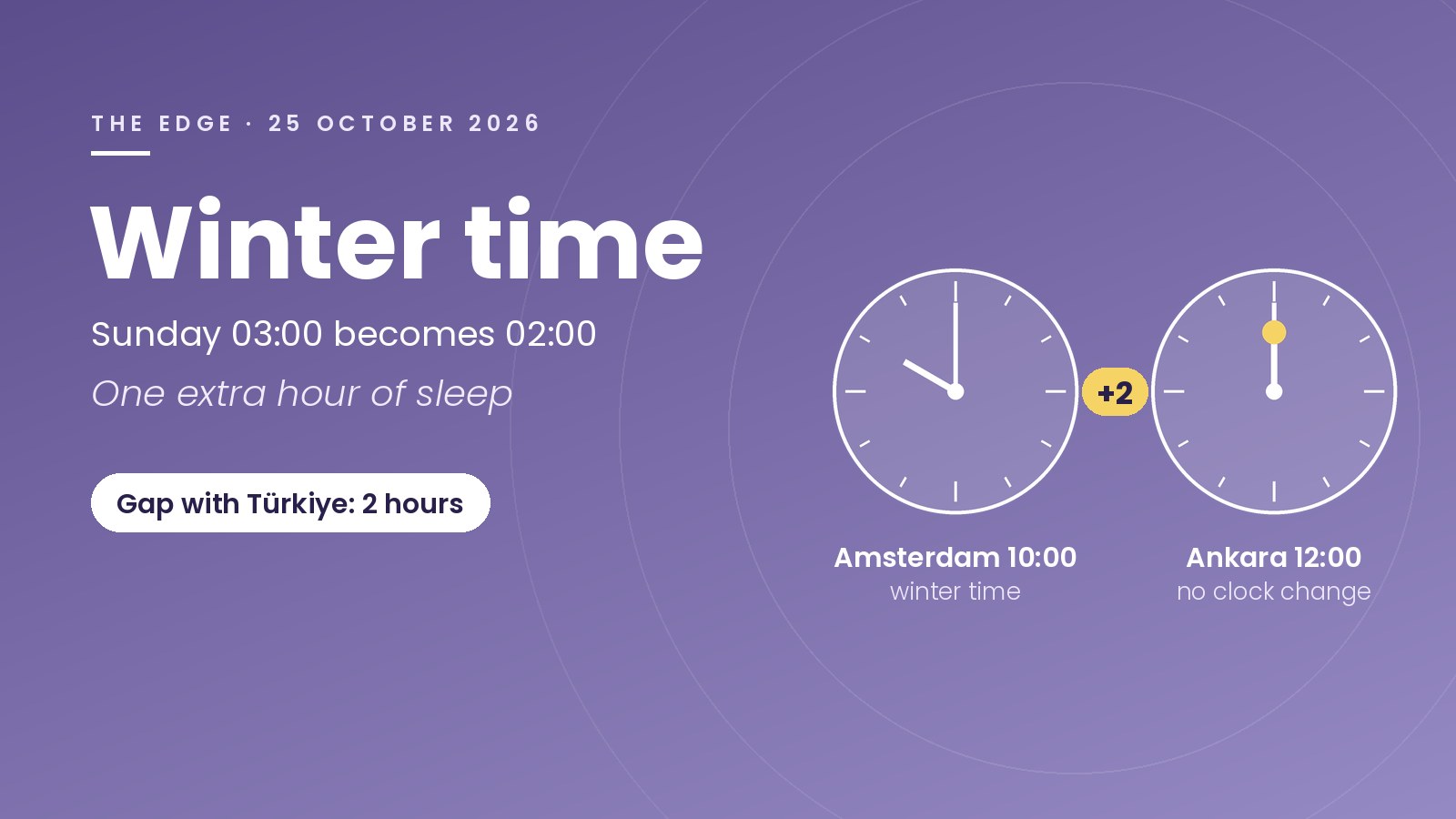
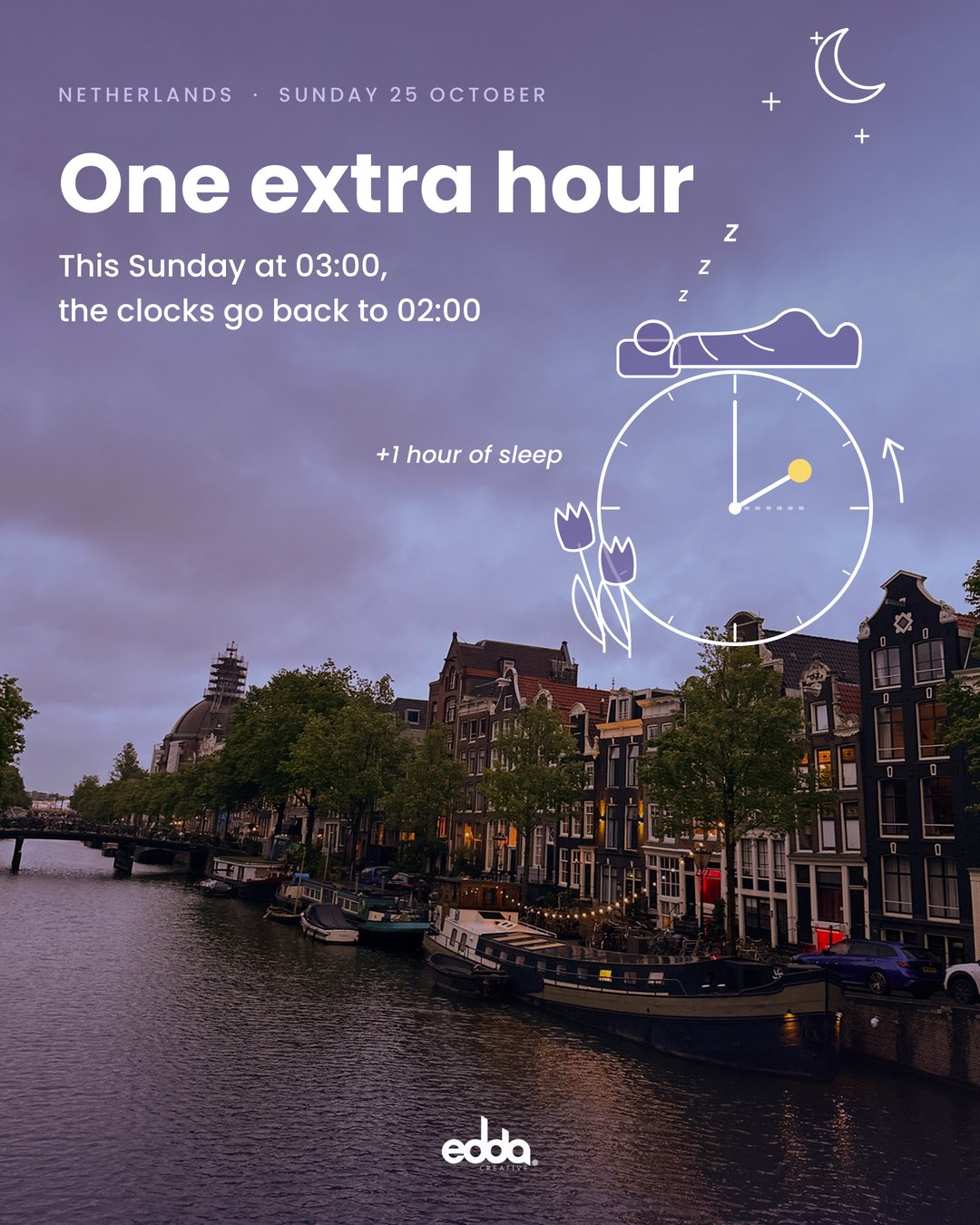
Winter time starts in the Netherlands in the early hours of Sunday 25 October 2026. At 03:00, the clocks go back one hour to 02:00, which means everyone gets an extra hour of sleep. Smartphones and computers usually make the change automatically; you will need to turn back any clocks you set by hand.
Winter time at a glance
- When: Sunday 25 October 2026 at 03:00
- What happens: The clocks go back one hour: 03:00 becomes 02:00.
- Which time applies: Central European Time (standard time). The Netherlands uses UTC+2 in summer and UTC+1 in winter.
- Why: The Netherlands introduced summer time in 1977 to stay in line with its neighbours. In the European Union, the start and end dates are set by Directive 2000/84/EC: summer time begins on the last Sunday of March and ends on the last Sunday of October.
- Next change: Summer time returns on Sunday 28 March 2027, when the clocks go forward one hour.
The time difference with Türkiye grows to 2 hours
Türkiye has used permanent summer time since 2016 and no longer moves its clocks forward or back. Turkish time is UTC+3 all year round. When the Netherlands switches to winter time, the difference between the two countries changes:
- In summer: 1 hour (10:00 in Amsterdam = 11:00 in Ankara and Istanbul)
- From 25 October 2026 to 28 March 2027: 2 hours (10:00 in Amsterdam = 12:00 in Ankara and Istanbul)
For teams, clients and partners working between the Netherlands and Türkiye, this small change affects everything from meeting times to campaign planning. Meeting culture matters as much as the time difference; we cover it in One Meeting, Two Meanings.
A short checklist for teams working across both countries
- Review recurring meetings. Calendar apps fix the time to the organiser’s time zone. A weekly meeting set for 09:30 in Amsterdam now starts at 11:30 for participants in Türkiye.
- Recalculate your shared working hours. A lunch break from 12:00 to 13:00 in Türkiye now falls between 10:00 and 11:00 in the Netherlands. By 17:00 in the Netherlands, the working day in Türkiye has long ended.
- Check the time zone of scheduled posts. Check which time zone your social media and email scheduling tools use, and update posting times based on where your audience is.
- State the time zone in invitations. Writing both times, such as “10:00 (Amsterdam) / 12:00 (Türkiye)”, in international meeting invitations prevents confusion.
- Update customer communication. If your website or email signature lists opening hours in a specific time zone, check that they are still correct for the winter period.
One extra hour
With winter time, mornings get a little lighter and evenings get dark earlier. The hour gained on Saturday night is a good chance to start the week a little more rested, and perhaps a good moment to review your plans as the last quarter of the year begins.
How Edda Creative helps
With our team in Amsterdam and Ankara, Edda Creative works across two time zones every day. For brands doing business between the Netherlands and Türkiye, we plan content calendars, campaigns and posting times around the rhythm of both markets, and adapt communication to the language and business culture of each country. Sales and customer relationships stay with the brand’s own team; we make sure the communication happens at the right time and in the right language. Read more on our business development and marketing consultancy page.
Frequently asked questions
Do the clocks go forward or back for winter time?
Back. On Sunday 25 October 2026 at 03:00, the clocks are set to 02:00.
Does Türkiye change its clocks?
No. Türkiye has used permanent summer time since 2016, so the clocks do not go forward or back.
What is the time difference between the Netherlands and Türkiye?
2 hours from 25 October 2026 to 28 March 2027, and 1 hour during summer time.
When does summer time start again?
On Sunday 28 March 2027. The clocks in the Netherlands go forward one hour, and the difference with Türkiye returns to 1 hour.
Information compiled from official sources as of 24 October 2026.
Sources
- Rijksoverheid – Klok verzetten Nederland (Dutch government)
- EUR-Lex – Directive 2000/84/EC on summer-time arrangements
- Official Gazette of Türkiye (Resmî Gazete), 8 September 2016 – Council of Ministers Decision 2016/9154 on year-round summer time