6 min read
Marketing is more than social media: the five areas under the marketing umbrella
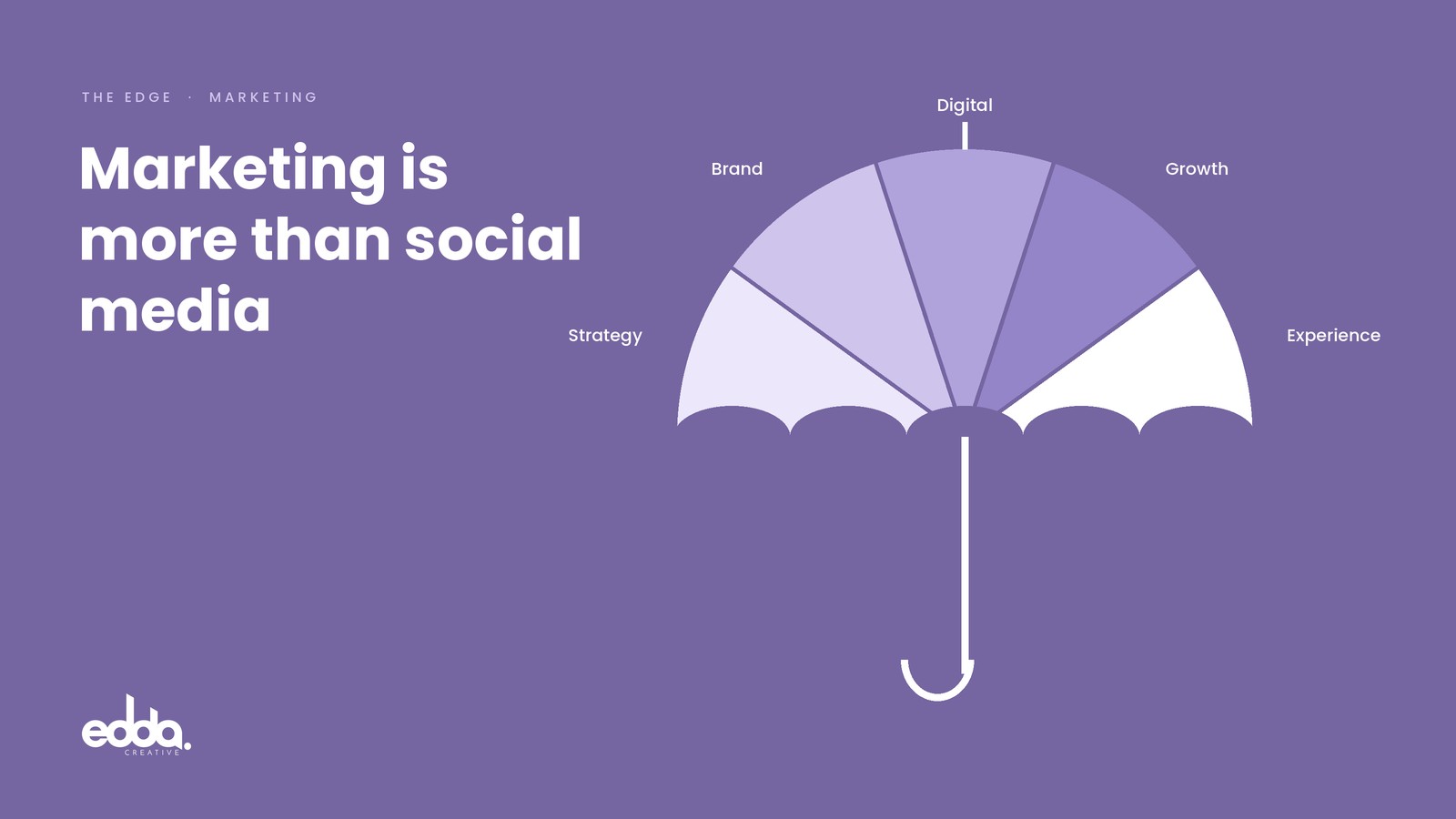
“We have a marketer, they run our Instagram.” In many companies, marketing is squeezed into that one sentence. Yet social media is only one of the most visible pieces under the marketing umbrella. Under it sit strategy, brand, digital channels, growth experiments and customer experience. In this article we look at these five areas, the order between them, and how to spot which one is missing in your company.
In short
- Marketing is a system, not a channel. The American Marketing Association defines marketing as the processes for creating, communicating, delivering and exchanging offerings that have value for customers and society. Posting content is only the “communicating” part.
- There are five areas under the umbrella: strategy, brand, digital marketing, growth and customer experience.
- Order matters: budget spent on digital channels before strategy and brand are clear often tells the wrong message to the wrong people.
- Balancing short and long term: research by Les Binet and Peter Field for B2B suggests putting about 46% of budget into brand building and 54% into activation aimed at immediate response.
Why is marketing so misunderstood?
Because its most visible part is social media. You cannot see a company’s strategy, positioning or audience analysis from the outside, but everyone can see its Instagram account. So when people hear “marketing”, they first think of posts, ads and follower counts.
The problem is that companies start with the visible part and never build the invisible one. The result is familiar: there is a steady stream of posts but nobody knows who they are for; ad budget is spent but nobody knows which message works and why; there is a website but the sales team hesitates to send it to clients.
The five areas under the umbrella
1. Strategy: who, what and why?
Market and competitor analysis, audiences and segments, positioning and measurable goals. This layer sets the questions everything else has to answer: whose problem do we solve, why are we different, and what do we want to have achieved a year from now? Marketing without strategy is like setting off without a route.
2. Brand: how are we recognised?
Visual identity, tone of voice, brand positioning and the brand equity built up over time. A brand is more than a logo; it is the decision system that makes customers recognise you the same way at every touchpoint.
3. Digital marketing: where are we visible?
Website, SEO, content, social media, email and advertising. This layer is the door through which strategy and brand reach the outside world. When it works, you are in the right place with the right message when customers look for you. Social media is only one part of this layer; for B2B companies it is often less decisive than the website and search visibility.
4. Growth: how do we learn what works?
A/B testing, conversion rate optimisation, measurement and repeatable growth loops. This layer turns marketing from guesswork into learning: which headline was read more, which page brought in more enquiries, which channel deserves the budget? You cannot improve what you do not measure.
5. Customer experience: how do customers experience us?
Customer journeys, satisfaction measures such as NPS, and loyalty. Marketing does not end at the first contact. The proposal, the contract process, communication during delivery and after-sales support are all part of the brand. If the customer experience is weak, even the best campaign will not create repeat customers.
Why the order matters
The five areas are connected, but they are not built at the same time. A healthy order usually looks like this:
- Strategy first: audience, positioning and goals are written down.
- Then brand: the identity and language that carry this strategy are built.
- Then channels: website, content, social media and ads work with that language.
- Continuous measurement: results are read, what works is scaled, what does not is dropped.
- Experience at every touchpoint: customers see the same brand after the sale too.
Many companies live this order in reverse: they hire a social media agency first, and when results do not come they conclude that “marketing does not work for us”. What is missing is usually not the channel, but the strategy and brand decisions behind it.
Balancing short and long term
Part of a marketing investment goes into work that should deliver results right away (ads, campaigns, offers), and part into work that pays off over time (brand awareness, trust, being remembered). Research by Les Binet and Peter Field for the LinkedIn B2B Institute in 2019 suggests that B2B companies put about 46% of their budget into brand building and 54% into activation. It is not an exact formula, but the message is clear: a company that only invests in today’s results is not building tomorrow’s demand.
Which area is missing in your company? A five-question check
- Strategy: Can you describe your target customer and how you differ from competitors in one paragraph, clearly enough that everyone would write it the same way?
- Brand: Do your website, presentation, LinkedIn page and proposal look and sound like they come from the same company?
- Digital: Which words do customers use to find you, and what do they see when they do?
- Growth: Can you say, with numbers, which marketing activity worked in the last six months?
- Experience: Would customers recommend you after working with you, and do you know?
Any question you answer with “no” or “not sure” shows where the umbrella leaks.
Where Edda Creative sits under the umbrella
We work directly on the first three layers and on the communication side that supports the last two: strategy and marketing consultancy, brand identity and communication design, digital marketing and social media management. Measurement and reporting are part of every engagement. Sales and customer relationships stay with you; we make sure your brand looks consistent and right at every touchpoint of that relationship.
Frequently asked questions
Are marketing and social media management the same thing?
No. Social media is one of the digital channels of marketing. Marketing covers strategy, brand, digital channels, measurement and customer experience together.
Where should marketing start?
With strategy. Choosing channels before audience, positioning and measurable goals are written down means spending the budget on guesswork.
How should B2B companies balance brand and sales-focused marketing?
Binet and Field’s B2B research suggests putting about 46% of the budget into brand building and 54% into activation. The right ratio depends on the sector and the company’s stage.
Should a small company invest in all five areas?
Not all at once. But digital spending without a foundation of strategy and brand usually underperforms, and that foundation can be built on a small budget too.
Sources
- American Marketing Association: Definitions of Marketing
- LinkedIn B2B Institute (2019): How B2B marketing really drives growth – Les Binet and Peter Field
Let’s find out together which layer of your marketing is missing. Write to us at info@eddacreative.com.