6 min read
The founder left, the founder returned: what Nvidia’s 11 days tell brands
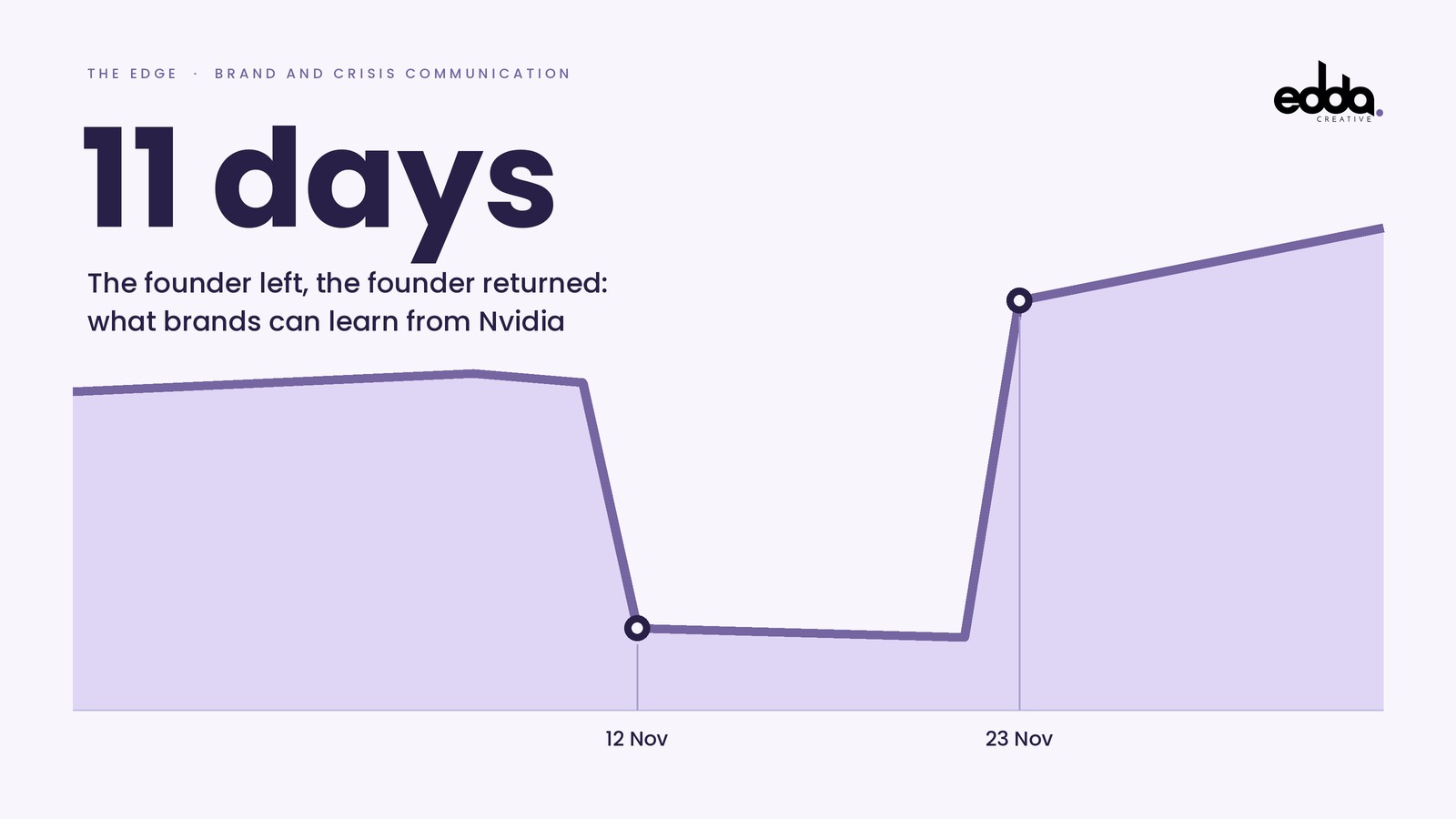
On 12 November 2026, Nvidia announced that founder Jensen Huang had stepped down, effective immediately, as CEO, a role he had held for 33 years. A few days later the board chair said there was no intention to bring him back. On 23 November, the same board unanimously reinstated Huang as CEO, and the shares rose more than 30% during the day. This article is not about the private side of the story. It is about what it tells brands: the risk of a founder-dependent brand, the gap left in an announcement, the cost of saying “never”, and what actually rebuilds trust.
In short
- 12 November: Nvidia announced that Huang had stepped down as President, CEO and board member, effective immediately. The official statement gave no reason. CFO Colette Kress became interim CEO and Harvey C. Jones the company’s first board chair.
- Background: Media reports covered Huang’s private life and raised questions about a possible link to a foreign intelligence effort. The company opened an investigation led by a committee of independent directors.
- 17 November: The board set up a standing committee for national security and export control oversight. The same week, the board chair said the board did not intend to reinstate Huang.
- 23 November: The board unanimously reinstated Huang as President and CEO, citing his candour and ability to lead, and input from senior levels of the US government. The investigation continues.
- Markets: The shares lost significant value during the resignation period and rose more than 30% on the day of his return.
1. A founder brand is an asset and a risk
When a company’s market value swings this much within days depending on whether one person is in office, it shows how closely that person is tied to the brand. With his leather jacket and keynote stage, Jensen Huang had become the face of Nvidia. Investors, customers and employees largely looked at the company through him.
This is not unique to tech giants. In many SMEs in Türkiye and the Netherlands, the brand is effectively the founder: the client relationships sit with them, the company’s voice is their LinkedIn profile, and proposals go out under their signature. That is a strong advantage in the early years of growth. But if the founder is suddenly absent, falls ill or becomes the subject of negative news, the brand is shaken with them. The way to reduce this key-person risk is not to hide the founder, but to make the brand visible through the team, processes and principles as well.
2. Others fill the gaps in your statement
The official statement of 12 November did not explain the resignation. That may be understandable from a legal point of view. From a communication point of view, however, everything the company did not say was filled in by the press, social media and speculation. The story spread in other people’s words rather than Nvidia’s.
In a crisis you do not have to say everything, and often you cannot. But you can almost always say three things: acknowledge what happened, explain what you are doing (investigation, interim leadership, process), and say when the next update will come. Nvidia did the second part well: the message on interim leadership and uninterrupted operations was clear from day one.
3. The cost of saying “never”
A few days after the resignation, the board chair said clearly that there was no intention to bring Huang back. Six days later the opposite decision was announced. The statement explains the reasons, yet for an outsider the first question is: how much can I trust the next announcement?
Firm statements are tempting in crisis communication because they seem to close down uncertainty. But when circumstances are changing fast, a firm promise can turn against the brand at the next step. The difference between “we have no such plans at this time” and “we will not do this” decides whether credibility survives a few days later.
4. Structure, not words, rebuilds trust
The most notable part of the reinstatement announcement is not Huang himself but the structure built around him: the independent committee continues its investigation with independent counsel, a new oversight committee for national security and export control has been set up, and the company is recruiting a Chief Compliance Officer. Huang said he fully supports the investigation and will cooperate.
That is an important lesson for brands: trust does not come back with the words “trust us”, but with mechanisms that check that trust. After a mistake, a complaint or a reputational issue, the strongest thing a company can communicate is what it has put in place so that it does not happen again.
Five questions for your brand
- If your founder or managing director were away for a month, what would your brand say? Does the company’s voice depend on one person, or can the team, experts and company page speak too?
- Who speaks in a crisis? Are the spokesperson, approval chain and first-24-hour steps written down?
- Is a first statement ready? Even if you cannot share the reasons, do you have a short draft that says what happened, what you are doing and when you will update next?
- Can you avoid absolute statements? In an uncertain situation, can you stay honest and flexible with phrases like “at this time” and “as far as we know”?
- Are the structures that show trust visible? Do you tell customers about your quality, compliance, confidentiality or ethics processes?
Where Edda Creative stands
We work with companies in technology, industry and defence on brand and communication strategy. Part of that work is making sure the brand builds trust without depending on a single person: clarifying the company’s voice, making the team and expertise more visible, and preparing in advance the messages and approval flow to use in a crisis. See our strategy and branding and communication design pages for more.
This article is based on public company statements and news reports. It is not an assessment of anyone’s private life, nor investment advice. As the investigation continues, details may change.
Frequently asked questions
Why did Jensen Huang step down as Nvidia CEO?
Nvidia’s official statement of 12 November 2026 gave no reason. Media reports covered Huang’s private life and raised questions about a possible link to a foreign intelligence effort. The company opened an investigation led by independent directors.
When was Jensen Huang reinstated as CEO?
On 23 November 2026. The board unanimously reinstated Huang as President, CEO and board member. Colette Kress continues as CFO and Harvey C. Jones as board chair.
How did Nvidia shares react?
The shares lost significant value during the resignation period. On the day his return was announced, they rose more than 30% during trading, according to news reports.
How can a founder-dependent brand be protected?
Not by hiding the founder, but by making the brand visible through the team, processes and principles as well. Preparing in advance who speaks in a crisis, the approval flow and a draft first statement also reduces the risk.
Sources
- NVIDIA, SEC Form 8-K (12 November 2026): CEO transition announcement
- NVIDIA Newsroom (17 November 2026): National Security and Export Control Oversight Committee
- NVIDIA, SEC Form 8-K (23 November 2026): reinstatement of Jensen Huang
- TechCrunch: Nvidia reverses course and brings Jensen Huang back as CEO
- Yahoo Finance: Jensen Huang returns as Nvidia CEO, shares surge more than 30%
Want a brand that builds trust without depending on one person? Write to us at info@eddacreative.com.