5 min read
Sinterklaas 2026: from a bishop of Myra to the Dutch 5 December tradition
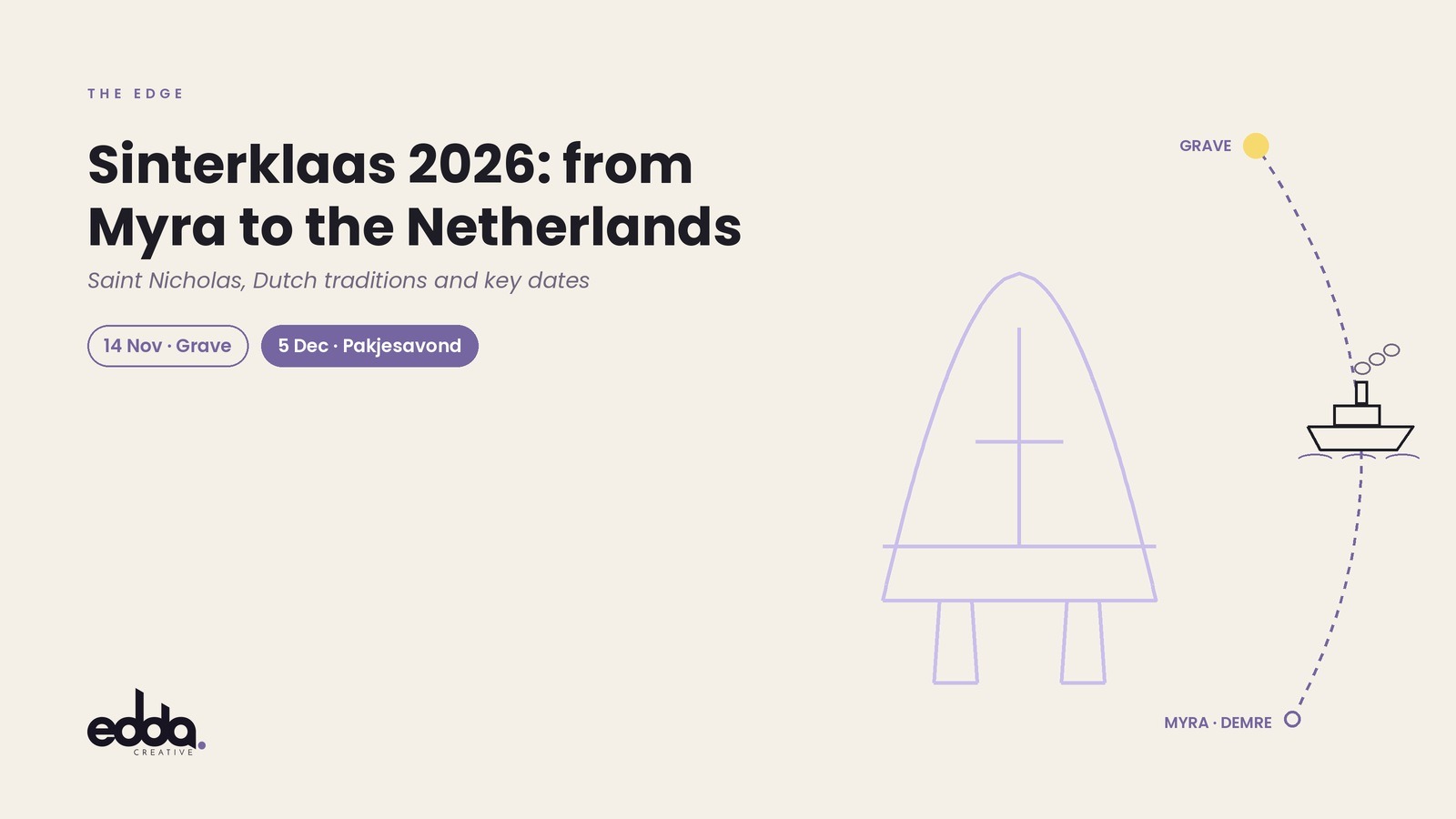
In the Netherlands, mid-November starts with an arrival. Sinterklaas comes “from Spain” by steamboat, with his white horse and his helpers, the Pieten, and stays until the evening of 5 December. In 2026 the national arrival (landelijke intocht) took place on Saturday 14 November in Grave, a fortified town on the river Maas in North Brabant. The figure behind the tradition goes back to Saint Nicholas, bishop of ancient Myra, today’s Demre on Türkiye’s Mediterranean coast.
Sinterklaas 2026 at a glance
| Date | What happens |
|---|---|
| Monday 9 November 2026 | The children’s daily news show Sinterklaasjournaal started (NPO Zapp / NPO 3, daily around 18:00). |
| Saturday 14 November 2026 | National arrival in Grave (municipality of Land van Cuijk, North Brabant), broadcast live on NPO 3 from 12:00. According to Omroep Brabant, it was the first national arrival in Brabant since 2000. |
| Sunday 15 November 2026 | Amsterdam’s own arrival (towns and cities hold local arrivals on different days). |
| Through November | Children put out their shoes from time to time (schoen zetten). |
| Saturday 5 December 2026 | Pakjesavond, the evening of presents and the high point of the season. |
| Sunday 6 December 2026 | Feast day of Saint Nicholas in the Western churches. |
Who was Saint Nicholas?
According to Encyclopaedia Britannica, tradition holds that Nicholas was born in Patara, a port in ancient Lycia, and became bishop of Myra in the same region. He probably lived in the 4th century. Britannica also notes that no historical document confirms his existence and that most stories about his life are legends. He is regarded as a patron of children and sailors. His feast day is 6 December in Western churches and 19 December in Eastern churches.
In 1087, Italian sailors or merchants took his remains from Myra to Bari in Italy, which, according to Britannica, greatly increased his popularity in Europe.
Myra lies in today’s Demre, in Antalya province. The St. Nicholas Church in Demre has been on UNESCO’s World Heritage Tentative List since Türkiye’s Ministry of Culture submitted it on 25 February 2000. The UNESCO entry says the church was built in the 4th century for the city’s bishop.
From Myra to the Netherlands
The Netherlands Open Air Museum (Nederlands Openluchtmuseum) describes the main steps:
- Middle Ages: the veneration of Saint Nicholas merged with another December feast for children.
- 16th century, Reformation: Protestants objected to the veneration of saints, so the feast became less religious and the name became “Sinterklaas”. Where it was banned, it was often celebrated quietly on the evening of 5 December, which is still the date today.
- 17th century: a painting by Jan Steen in the Rijksmuseum shows an early version of the feast.
- Around 1850: a schoolmaster’s booklet added the white horse and the steamboat.
- 19th century: Sinterklaas became a national folk festival.
Britannica adds that Dutch colonists brought Sinterklaas to New Amsterdam (now New York) in the 17th century, where the tradition merged with other folklore and grew into the American Santa Claus.
Is Sinterklaas the same as Santa Claus?
They share a root, but in the Netherlands they are different figures. Sinterklaas wears a bishop’s robe and mitre, brings presents on 5 December and then leaves the country. The Christmas figure is called the Kerstman.
Traditions, from shoes to poems
- Putting out a shoe (schoen zetten): children leave a shoe by the fireplace or door in the evening, with a carrot for Sinterklaas’s horse, and find a small present or sweets in it the next morning.
- Pepernoten and chocolate letters: small spiced biscuits and a chocolate letter, usually the first letter of a person’s name.
- Pakjesavond (5 December): presents arrive in a sack left on the doorstep, and the family takes turns unwrapping them.
- Poems: almost every present comes with a humorous poem about the person receiving it.
- Surprises and drawing names: adults usually draw names in advance and hide the real present inside a handmade, humorous wrapping, the surprise.
- Sinterklaasjournaal: a daily children’s news programme that follows Sinterklaas and his helpers until 5 December.
Tips if you live in the Netherlands as an international
- Schools and day-care centres usually hold their celebration on a day close to 5 December; the exact date differs per school, so watch for its announcement.
- Check your municipality’s website for the local arrival date and time; it gets crowded in the larger cities.
- If your group draws names, the poem doesn’t have to be in Dutch. Funny and personal is what counts.
- For more in the capital this month, see our guide to Amsterdam in November 2026.
Frequently asked questions
When did Sinterklaas arrive in the Netherlands in 2026?
The national arrival took place on Saturday 14 November 2026 in Grave and was broadcast live on NPO 3. Towns and cities hold their own arrivals on different days.
When is pakjesavond in 2026?
Saturday 5 December 2026. Saint Nicholas’s feast day, 6 December, falls on a Sunday.
What is the link between Sinterklaas and Türkiye?
Sinterklaas is based on Saint Nicholas, who according to tradition was born in Patara and became bishop of Myra, today’s Demre in Antalya province. The St. Nicholas Church in Demre is on UNESCO’s World Heritage Tentative List.
Is Sinterklaas the same as Santa Claus?
Both go back to Saint Nicholas; the American Santa Claus developed from the Sinterklaas tradition that Dutch colonists brought to New Amsterdam. In the Netherlands, Sinterklaas (5 December) and the Kerstman (Christmas) are separate figures.
Sources
- Encyclopaedia Britannica – Saint Nicholas
- UNESCO World Heritage Tentative List – St. Nicholas Church, Demre (2000)
- Netherlands Open Air Museum – Het Sinterklaasfeest (Dutch)
- The Hague International Centre – Celebrating Sinterklaas for beginners
- Omroep Brabant – National arrival 2026 in Grave (24 February 2026)
- Intocht Sinterklaas 2026 – broadcast details (NPO 3)
- TV Gids – Sinterklaasjournaal 2026 start date