8 min read
12 questions to close the year: what did your brand learn in 2026, and what should it drop in 2027?
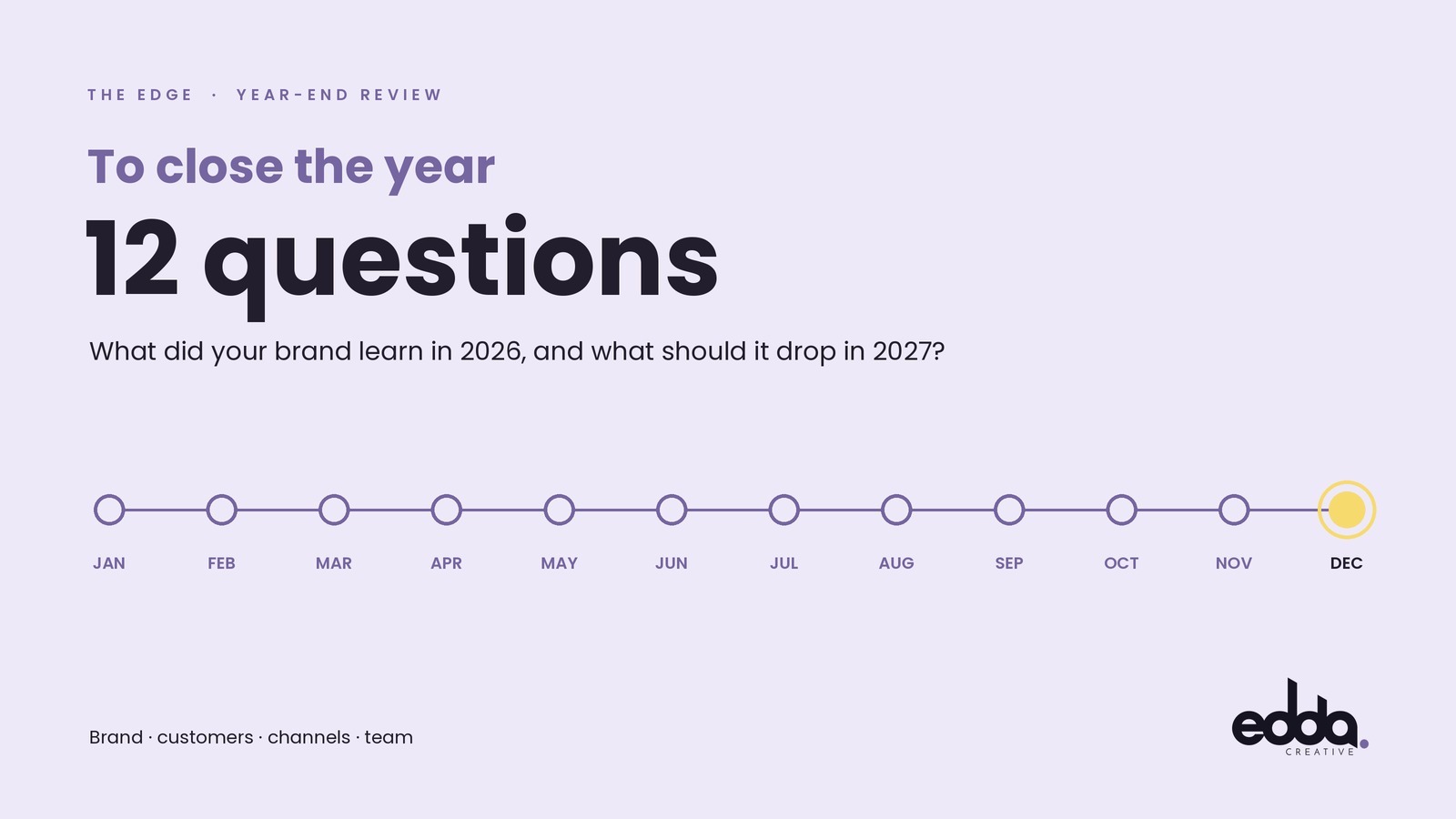
For most companies, December is when budgets close, reports come in and next year’s plan gets written. But the most valuable work starts before the numbers, with an honest question: what did our brand learn this year, and what should we stop doing in 2027?
This guide brings together 12 questions for a year-end brand and marketing review, grouped into four themes: brand and message, customers and markets, channels and content, and team and ways of working. For each question we explain why it matters and where to look for the answer. At the end you will find a stop – continue – start table to turn your answers into a 2027 plan.
In short
- When: the first two weeks of December, before the holidays and before the 2027 budget is final.
- How long: about half a day including preparation; the meeting itself needs 60–90 minutes.
- Who: marketing, sales and anyone who talks to customers directly; in small companies, the founder plus two or three people.
- Output: three priorities, a “we are stopping” list and a clear plan for the first quarter of 2027.
How to prepare
A good year-end review depends on having a few documents ready before the meeting. When everyone looks at the same data, the discussion is built on facts rather than guesses.
- Sales and proposal list: proposals sent, won and lost this year, ideally with the reason for each loss.
- Website and search data: Google Search Console’s performance report shows the last 16 months, enough to compare this year with last year. In Google Analytics 4, data in explorations is kept for 2 or 14 months depending on your property settings, so export the reports you need before the year closes.
- Social media and newsletter statistics: saves, shares, profile visits and clicks to your site matter more than follower counts.
- Customer voices: reviews, emails, meeting notes and what you heard at trade fairs.
- Budget: a summary of spend per channel.
Brand and message
1. How do your customers describe you in one sentence?
Your brand is defined less by the line on your website than by what customers say when they recommend you. The gap between the two is next year’s communication brief.
Read the past year’s reviews, testimonials and customer emails. Write down the three phrases that recur most and put them next to your own description.
2. Which message really landed this year?
Every year brings many campaigns and posts, but usually only one or two messages stand out. Those show where the brand’s real strength lies.
List your most saved and shared posts, most read articles and emails with the most replies. What do they have in common?
3. Does your brand look and sound the same everywhere?
When the website, sales deck, trade fair stand, LinkedIn and proposals are made by different people, the brand fragments. Inconsistency quietly erodes trust.
Put one example of each material from this year side by side: are logo use, colours, language and tone consistent? Whatever differs belongs on your 2027 brand and communication design agenda.
Customers and markets
4. Where did your best customers come from?
Your best customer is not necessarily the one who pays most, but the one you enjoy working with, who pays on time and comes back. Knowing where they came from tells you where to put your energy in 2027.
List your five best customers and note the first point of contact for each: search, referral, trade fair, LinkedIn or an existing client.
5. Why did you lose the proposals you lost?
Wins lift morale; losses teach. Price is often the visible reason, but the real one is frequently how the offer was explained, its timing or a lack of trust.
Go through lost proposals one by one. Where possible, send a short, polite email asking why; the answers are worth more than your assumptions.
6. Which market or sector showed unexpected interest?
Unplanned enquiries are often a door the market is opening for you: first questions from abroad, or proposal requests from a new sector.
Review website traffic by country and city, and incoming requests by sector. If a pattern repeats, treat it as a deliberate test in 2027. If you are considering a new market, see our business development and marketing consultancy page.
Channels and content
7. Which channel did not repay the effort?
Every channel takes time. One that gets regular content but brings neither visibility nor enquiries drains energy from other work.
For each channel, put time and budget next to results: visibility, site visits, enquiries. Rebuild or drop the channel that does not deliver.
8. Which content still works a year later?
News-style posts age quickly; guides, checklists and articles that answer common questions bring traffic for months. That difference is the backbone of your 2027 content plan.
In Search Console, look at the pages with the most impressions and clicks over the past 12 months. Content published early in the year that still attracts visits can become the template for new pieces.
9. Which trade fair or event was really worth it?
Trade fairs are among the biggest budget lines. Without a review, teams return to the same fair out of habit or miss a valuable one.
For each fair, note the total cost, the number of qualified conversations at the stand and the business that followed in the next three months. For 2027, see our 2027 Netherlands trade fair calendar and trade fair preparation checklist.
Team and ways of working
10. What did you reinvent every month?
Decks, proposal texts and social media plans rebuilt from scratch each month are repetitions a template or process could solve.
Ask the team for the three tasks that repeated most this year. Give each a template, a checklist or an owner.
11. Where did you lose time waiting for approval?
Most campaigns are not delayed by a lack of ideas but by waiting in the approval chain, and delays become missed opportunities.
Look at the timelines of recent projects: was it the work that took long, or the sign-off? Write down who approves what, and within how many days, for 2027.
12. What will you stop doing in 2027?
Adding new work to next year is easy; deciding what to stop is hard. Yet it is the only way to make room for something new.
From the answers to the first eleven questions, pick at least three “we are stopping” items: a channel, a habit, a meeting or a message that no longer fits your brand.
Turn the answers into a plan: stop, continue, start
Collect the answers in a simple table like the one below. Keep each column to three items at most; long lists do not get done.
| Stop | Continue | Start |
|---|---|---|
| The channel or campaign that did not deliver | The channel your best customers came from | A small test in the market that showed unexpected interest |
| Work rebuilt from scratch each month | The type of content still read a year later | Templates and owners for recurring tasks |
| The fair or event that was not worth it | The core message that landed | The fix suggested by lost proposals |
From review to 2027 plan
- Pick three priorities: no more than three marketing priorities for the whole year, written down where everyone can see them.
- Build the calendar now: public holidays, trade fairs and industry events set the rhythm of the year. Add them to your plan early; our 2027 public holidays guide covers the Netherlands and Türkiye.
- Account for a changing environment: AI-powered search and new content and advertising rules will shape communication in 2027. See our marketing trends for 2027.
- Make the first 90 days concrete: write down what happens from January to March, who owns it and how it will be measured. Update the rest at the end of the quarter.
Five common mistakes
- Looking only at numbers and not listening to customers.
- Making the review one person’s job.
- Deciding to continue everything and stop nothing.
- Writing a plan without owners and dates.
- Leaving the review until mid-January, when the year has already started.
What Edda Creative does
Edda Creative works from Amsterdam and Ankara with brands worldwide to review the year and sharpen the next one: strategy and business development consultancy, brand and communication design, content planning and workshops for teams. Sales and customer relationships stay with you; we help you clarify what to say and how to say it. If you would like to review your year together, send a short email to info@eddacreative.com.
Frequently asked questions
When should you do a year-end marketing review?
Ideally in the first two weeks of December, when most of the year’s data is in, but before the holidays and before next year’s budget is final.
Who should take part?
Marketing, sales and anyone who talks to customers directly. In small companies, the founder and two or three colleagues are enough; what matters is having different perspectives in the room.
What data do you need?
A list of proposals and sales, Google Search Console and Google Analytics data, social media statistics, customer reviews and a budget summary per channel.
Is it worth it for a small business?
Yes. In small teams time is the scarcest resource, so seeing what does not work and stopping it makes an even bigger difference.
What comes after the review?
Put the answers into a stop–continue–start table, choose no more than three priorities and write an action plan for January to March with owners and dates.
Sources