6 min read
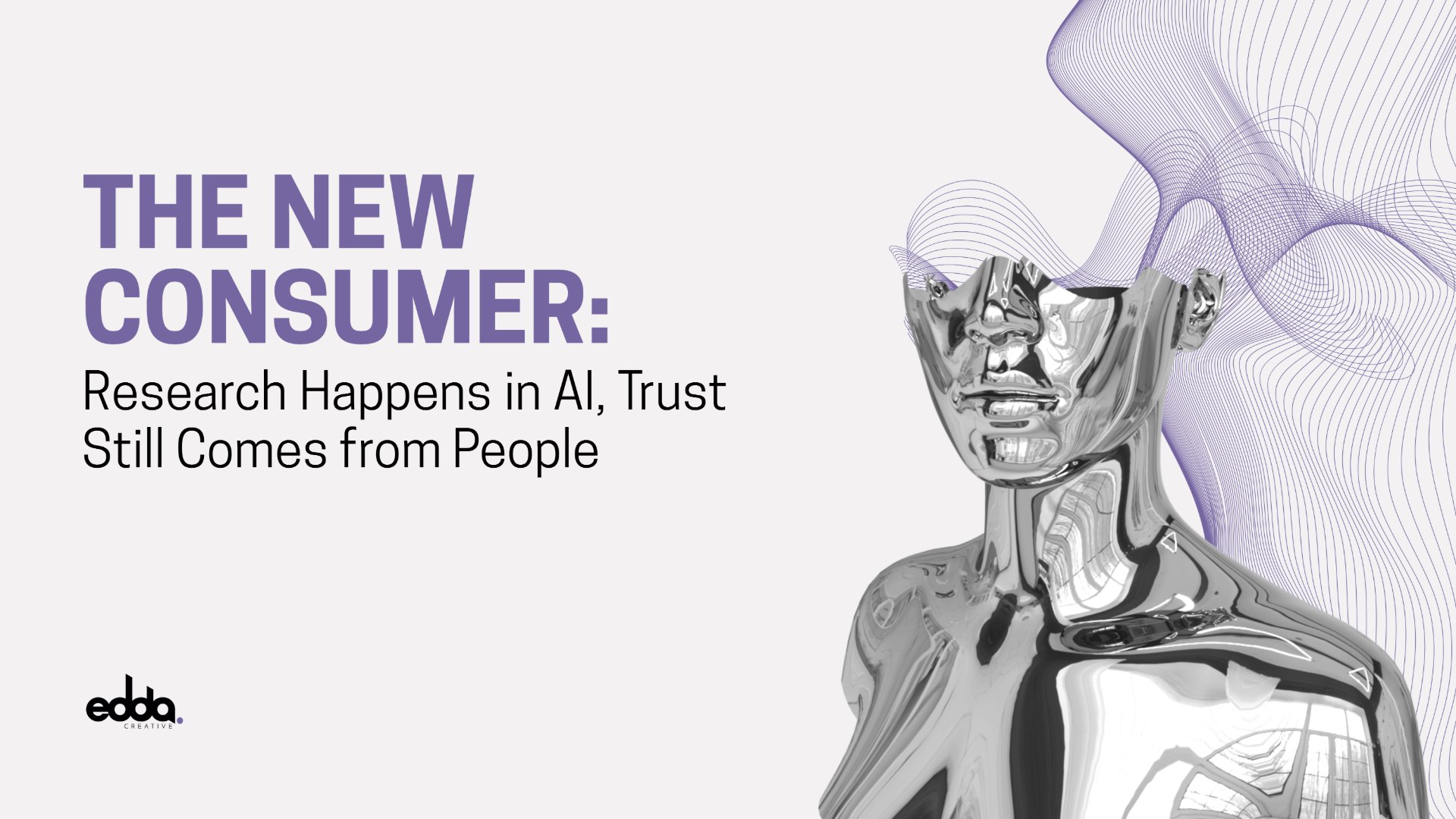
The New Consumer: Research Happens in AI, Trust Still Comes from People
Think about the last thing you bought that took a bit of thought. A pair of running shoes, a new laptop, a hotel for a weekend away. Chances are that at some point you typed your question into an AI assistant instead of a search bar. You are far from the only one.
Over the past few months, several large studies have tried to measure how this habit is changing consumer behaviour, in other words the way people discover and choose brands. We read through them and pulled together the findings that matter most for companies. Most of the data comes from the US and Western Europe, so read the numbers as a direction rather than a precise forecast for every market.
Shopping is now the most common reason people use AI
McKinsey’s State of the Consumer 2026, based on a survey of 4,863 people in Brazil, France, Germany, the UK and the US, found that 26% of consumers use generative AI when shopping. Other uses trail behind: health and wellness at 22%, trip planning at 21%, financial advice at 18%.
We expected a big gap between generations. It turned out to be smaller than we thought. Gen Z sits at 28%, millennials at 27% and Gen X at 23%. Even among baby boomers, about one in six uses AI to shop.
Studies with a narrower focus show even higher numbers. In a survey of 1,009 US consumers published in April by Exploding Topics, 77.6% said they had used AI to help with a purchase decision in the previous six months.
So whoever your customers are, some of them are already meeting your brand through an AI assistant, and that group is growing.
By the time they reach your site, they have mostly decided
Adobe tracks visits to US retail sites every month. In July 2026, traffic arriving from AI assistants was up 62% on a year earlier and more than twelve times its level in October 2024.
What caught our attention was how these visitors behave. Compared with other traffic, they are 60% more likely to buy and bring in 53% more revenue per visit. They stay on the site 59% longer and add products to their cart 28% more often. As recently as March 2025, this traffic was converting 38% worse than channels such as paid search and email.
The comparing now happens before the visit, inside a conversation with an AI. The customer arrives with a shortlist, often with a favourite already in mind. A good part of the persuading has been done in an answer you did not write.
One more detail from the same report deserves attention. When Adobe checked the homepages of a broad group of US retailers, around 39% of the content could not be read properly by AI models. Prices, product details and availability that a model cannot read are, for practical purposes, invisible to it.
Fewer clicks, and a new way to be left out
Search is shifting just as quickly. SparkToro’s analysis of Similarweb data found that 68% of Google searches in the US ended without a click to any website in the first four months of 2026, up from 60% in 2024. When an AI summary appears above the results, click-through drops by close to 60%.
Kantar’s AI Barometer, based on more than 2,000 people in the UK, shows what this means for brands. One in four consumers had asked AI for product recommendations. 15% said that if AI did not suggest a brand, they would assume it was not for them. And a third said they would be willing to buy directly inside an AI tool instead of going to the retailer’s website.
That 15% is, for us, the most important number in this issue. Missing from the answer no longer just costs you a visit. It can mean you never make it onto the list the customer is choosing from. AI tools describe a brand using whatever they can find about it online, which gives new weight to things many companies treat as housekeeping: clear and current information on your own site, consistent descriptions across platforms, and what other people say about you.
They use it, but they do not hand over the decision
This is where the picture gets more interesting. The same McKinsey report shows that trust in AI answers is low, even among the youngest consumers. Among Gen Z, net trust in AI responses is around 20%, compared with more than 50% for search engines and close to 70% for recommendations from family and friends.
The Exploding Topics survey shows the same hesitation from another angle. Even though most respondents had used AI to shop, the most common amount they would let an AI agent spend on their behalf without approval was zero dollars.
That matters, because the next step is already being tested. In what McKinsey calls agent-based commerce, AI agents compare products, apply loyalty benefits and complete the purchase for the customer. These services are being trialled in the US and are expected to reach Europe around 2027.
Meanwhile, consumers are watching their money closely. More than three in four use some strategy to cut their spending, and 82% say they keep products longer before replacing them. Value is increasingly judged on durability and resale, not only on price.
Put together, people use AI to research, narrow down options and compare prices, but when it comes to the final decision they still lean on friends, experts and other customers. AI draws up the shortlist; people provide the trust. Brands now have to work on both.
Where to start
Begin with a simple test. Ask two or three AI assistants about your category the way a customer would. Note whether your brand comes up, how it is described and which competitors appear. Half an hour of this often tells you more than a long report.
Next, look at your website through a machine’s eyes. Are your services, products, prices and contact details written in plain, readable text, or tucked away inside images and sliders? Is the information on your site consistent with your LinkedIn page, your Google Business Profile and the directories you appear in?
Then give people reasons to recommend you. Reviews, case studies, client stories and expert content are what AI tools pick up, and they are also what the person making the final decision still trusts.
Finally, change what you measure. With clicks falling, traffic on its own can be misleading. How often your brand is recommended, how many visitors go on to buy and how often customers refer others are now better signals.
In our previous issue we looked at why AI is not yet showing up in company profits. This issue looks at the same shift from the customer’s side.
At Edda, we look at how brands show up in this new path to discovery as part of our strategy, brand and digital communication work. If you would like to see together how your brand appears in AI answers, get in touch.
info@eddacreative.com · eddacreative.com
Sources
- McKinsey & Company, State of the Consumer 2026 (summary by Modaes, 3 July 2026)
- Exploding Topics, AI shopping survey of 1,009 US consumers (summary by TechWyse, 28 April 2026)
- Adobe Analytics, July 2026 AI traffic data (Digital Commerce 360, 19 August 2026)
- Adobe Analytics, Q1 2026 AI traffic data (Decrypt, 19 April 2026)
- SparkToro, 2026 zero-click study (summary by TechWyse, 11 June 2026)
- Kantar, AI Barometer UK (Research Live, 31 March 2026)