10 min read
Is AI making us more curious, or are we putting less effort into learning?
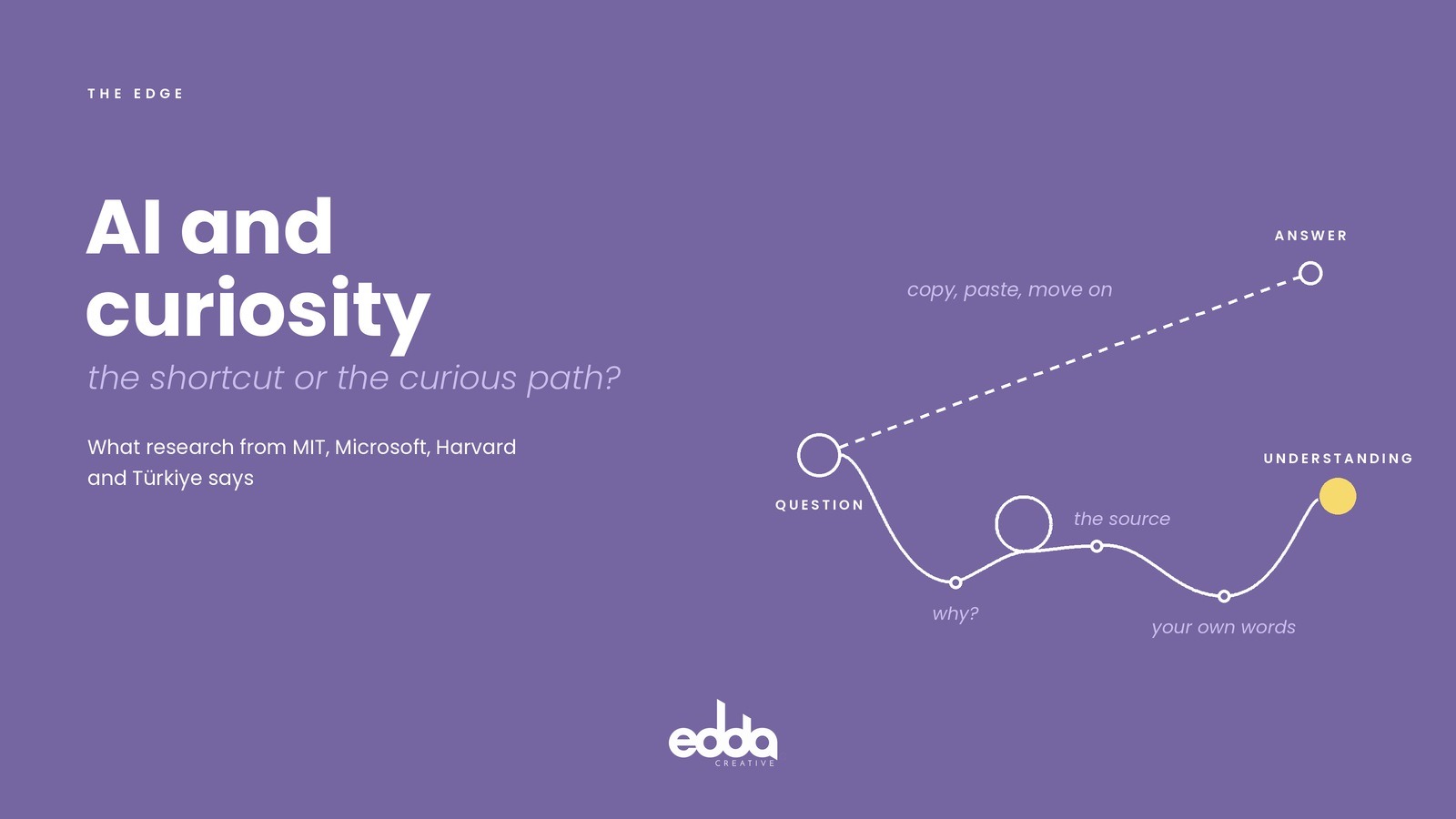
Has AI made you more curious, or are you putting less effort into learning than you used to? We have been hearing this question a lot lately, and to be honest, most of us are not sure about our own answer. On the one hand, we have a tool we can ask about anything, instantly. On the other, when answers come this easily, we wonder whether we are handing over the thinking as well.
The good news is that this is no longer just a feeling. Over the past two years, researchers at MIT, Microsoft, Harvard and Wharton have started studying it with experiments and surveys, and one of these studies took place in Türkiye. The findings do not all point in one direction, but they share a clear lesson: what decides the outcome is not AI itself, but how we use it.
In short: what does the research say?
- Getting the answer directly can weaken learning. In an experiment with nearly 1,000 high school students in Türkiye, students with unrestricted GPT-4 access did better in practice, but once the tool was taken away they scored 17% lower on the exam than students who never had it.
- The more we trust AI, the less we think critically. In a study of 319 professionals by Microsoft and Carnegie Mellon, people with higher confidence in AI reported less critical thinking.
- Well-designed AI can accelerate learning. In a Harvard physics course, an AI tutor that did not hand out answers but guided students step by step produced more than double the learning gains of in-class active learning.
- Curiosity can be supported too. In a study with 9- and 10-year-olds in France, an AI setup that offered cues instead of ready-made questions led children to ask more curious questions.
Do faster answers mean less effort?
The most talked-about study came from the MIT Media Lab. Researchers asked 54 participants to write essays: one group used ChatGPT, one used a search engine and one used no tools at all. Brain connectivity, measured with EEG, weakened as external support increased: it was strongest in the no-tools group and weakest in the ChatGPT group. An even more striking finding: in the first session, 15 of the 18 people in the ChatGPT group could not correctly quote from the essay they had just written, compared with 2 of 18 in each of the other groups. ChatGPT users also felt less ownership of their essays.
This study needs to be read with care. It is a preprint that has not yet been peer reviewed, the sample is small and other researchers have criticised its methods. Still, it puts numbers to a familiar feeling: when we let a text be written without thinking it through ourselves, it does not stay with us.
Research on working life paints a similar picture. Drawing on 936 real examples from 319 knowledge workers, Microsoft Research and Carnegie Mellon University found that people with high confidence in AI reported less critical thinking, while those confident in their own skills reported more. The researchers stress that critical thinking does not disappear but changes shape: it shifts towards verifying information, integrating responses into one’s own work and taking responsibility for the process.
A study of 666 people by Michael Gerlich also found a negative relationship between frequent AI use and critical thinking skills. The link was explained by “cognitive offloading”, handing the work of thinking over to the tool, and younger participants, who relied on AI the most, were affected most. As a correlational study it does not prove cause and effect, but its direction matches the other findings.
A striking experiment from Türkiye: same tool, two outcomes
The clearest evidence comes from a field experiment published in PNAS in 2025, carried out with nearly 1,000 students at a high school in Türkiye. Researchers from the Wharton School of the University of Pennsylvania split students into three groups: one used the standard GPT-4 interface for maths practice, one used a “GPT Tutor”, designed with input from teachers, that gave hints rather than answers, and one used no AI.
- Standard GPT-4 users: did 48% better in practice, but scored 17% lower than the no-AI group on the exam taken without the tool.
- GPT Tutor users: did 127% better in practice, with no negative effect on the exam.
The difference lies in what the tool allows. A tool that hands out ready answers boosts short-term performance but weakens learning. A tool that makes students think largely removes that negative effect, using the same technology. The researchers’ title says it all: generative AI without guardrails can harm learning.
The same tool can also grow curiosity
The other side of the coin is just as strong. In a randomised controlled trial at Harvard with 194 students, published in Scientific Reports, two topics in an introductory physics course were taught once with an AI tutor and once with in-class active learning. Students learning with the AI tutor achieved more than double the learning gains, in less time. They also reported feeling more engaged (4.1 vs 3.6 out of 5) and more motivated (3.4 vs 3.1). Again, the key was design: the AI tutor was built on education research to guide students step by step rather than give away the answer.
An example from France shows that curiosity itself can be supported. Researchers worked with 75 children aged 9 to 10. When the AI offered a few keywords and let the children form their own questions, instead of handing them ready-made ones, the children asked significantly more “curious questions”, open questions whose answers were not already in the text. Children in this group also reported more confidence in their own question-asking skills.
Two kinds of curiosity: which one are we feeding?
To explain these seemingly contradictory results, Punya Mishra and Danah Henriksen of Arizona State University revisit an old distinction from curiosity research. One kind of curiosity is the urge to close a specific information gap: the itch of “what is the answer?” The other is discovery curiosity: the pleasure of exploring a subject and making new connections.
AI satisfies the first kind very quickly. And because it tends to please its users, it answers in fluent, confident language that immediately removes the discomfort of not knowing, even when the answer is incomplete or wrong. The authors describe this as a trap: we may start to confuse closing a question with understanding it. Discovery curiosity only grows when we allow ourselves to stay with some uncertainty and keep asking “why?”
6 habits for using AI while keeping your curiosity
- Think first. Before asking AI a question, spend two minutes noting your own answer. Then compare; the gap is often where you learn the most.
- Ask for questions, not answers. A prompt like “don’t give me the answer, ask me questions that help me get there” turns the tool from an answer machine into a thinking partner. That is exactly what made the difference in the Türkiye experiment.
- Go one step further with “why?” Don’t stop at the first answer. Ask for the reasoning, the counterargument or when the answer would be wrong.
- Go to the source. If you got an important fact from AI, open and read the original source yourself. As the Microsoft study shows, a large part of critical thinking now consists of verification.
- Rewrite it in your own words. The MIT finding that people could not quote from their own essays shows why ownership matters. When you turn an AI draft into your own language, the text becomes yours and stays with you.
- Note what you learned. Ending the day with “What did I learn with AI today, and which question am I still curious about?” moves your use from consuming to learning.
What does this mean for teams and brands?
This debate is not only for schools. In marketing and communication teams, AI is now part of writing, presentations and research. In the MIT study, the essays of ChatGPT users started to resemble each other and the AI’s typical word choices, which is a warning for brands too: when everyone asks the same tool the same question, content starts to look alike. What sets you apart from competitors is still the quality of your team’s questions and its curiosity.
That is why the real question for teams is not “should we use AI?” but “how do we use it so that our team keeps thinking?” Teams that clearly decide which tasks to hand to AI, where human judgement is essential and how results are checked gain speed from the tool while keeping their thinking muscles. We shared our experience on this in our article “Teaching a team to be visible”, and research on consumer trust in the age of AI in “The new consumer”.
What does Edda Creative do?
With our team in Amsterdam and Ankara, we run training sessions and workshops that help brands and teams bring AI into their communication and content processes consciously. Together we decide where AI can support the work and where brand voice and strategic thinking need to stay with the team, and we set up a way of working in which the team keeps asking its own questions. See our education and workshops and business development and marketing consultancy pages for details.
Conclusion: those who keep asking questions win
AI does not, by itself, make us more curious or lazier. When we take the answer and move on, our learning effort drops; when we use it as a partner that asks questions, pushes back and makes us think, our curiosity can grow. Perhaps the question to ask ourselves is this: how many questions did I ask AI today, and how many of the answers did I truly understand?
Frequently asked questions
Does using AI reduce critical thinking?
Research shows that critical thinking declines when people trust AI too much and leave the thinking entirely to the tool. The effect is weaker among users who verify, question and rebuild answers in their own words.
Can AI help people learn?
Yes. In a randomised trial at Harvard, an AI tutor that guided students step by step produced more than double the learning gains of in-class active learning. What matters is that the tool supports thinking instead of handing out answers.
Is there research on AI and learning in Türkiye?
Yes. The study published in PNAS in 2025 was carried out with nearly 1,000 high school students in Türkiye. Students using standard GPT-4 scored 17% lower on an exam taken without the tool; this negative effect was not seen with the “GPT Tutor”, which did not give answers.
How can I use AI and stay curious?
Think of your own answer first, ask AI for questions instead of answers, keep asking “why?”, verify important facts at the original source and rewrite what you learn in your own words.
This article is based on research published as of 27 October 2026. Some studies are preprints; findings may change as new research appears.
Sources
- Kosmyna, N. et al. (2025). Your Brain on ChatGPT: Accumulation of Cognitive Debt when Using an AI Assistant for Essay Writing Task. MIT Media Lab, arXiv:2506.08872
- Comment on: Your Brain on ChatGPT (2026), arXiv:2601.00856
- Lee, H.-P. et al. (2025). The Impact of Generative AI on Critical Thinking. CHI ’25, Microsoft Research & Carnegie Mellon University
- Gerlich, M. (2025). AI Tools in Society: Impacts on Cognitive Offloading and the Future of Critical Thinking. Societies, 15(1), 6
- Bastani, H. et al. (2025). Generative AI without guardrails can harm learning: Evidence from high school mathematics. PNAS, 122(26)
- Kestin, G. et al. (2025). AI tutoring outperforms in-class active learning. Scientific Reports, 15, 17458
- Abdelghani, R. et al. GPT-3-driven pedagogical agents for training children’s curious question-asking skills, arXiv:2211.14228
- Mishra, P. & Henriksen, D. (2025). The Curiosity Paradox: How Sycophantic GenAI May Undermine Learning. TechTrends, 69