5 min read
After KvK Registration: Your First 90 Days Preparing for the Dutch Market
Almost every guide to setting up a company in the Netherlands ends in the same place: the notary, the KvK number, the VAT number and the bank account. These steps are necessary, but none of them brings you a customer. A company is a tool; the real goal is to sell in the Netherlands. In this issue we pick up where formation guides stop: what should happen in the first 90 days after KvK registration?
If you want the formation basics first, read Setting up a company in the Netherlands: what founders need to know, or see our company formation in the Netherlands page for costs and process.
First question: do you need a company yet?
Many firms start in the Netherlands with a company and look for customers afterwards. In some sectors, though, the first order can come from abroad through a distributor, a sales agent or a pilot customer. Testing demand first lets you set up the company at the right time and with the right structure.
A local company is usually needed when customers want a European invoice and a local contact, when you plan to bid for tenders or public contracts, when stock and logistics will be managed in Europe, or when you will employ people in the Netherlands. Without one of these signals, a market test may be the better first step.
Owning a company is not the same as living in the Netherlands
This is the most common mix-up. Owning a Dutch BV does not, on its own, give you the right to live or work there. There are three separate routes, each with its own process:
- Company ownership: can be arranged from abroad with a power of attorney; it needs no residence permit, but it does not grant one either.
- Ankara Agreement: offers Turkish nationals more favourable conditions for a self-employed residence permit; the IND assesses the business plan and whether the activity is genuine.
- Start-up visa: requires an innovative business idea and a recognised facilitator, with its own criteria.
Choosing the right route before incorporation directly affects the ownership structure and the first-year plan.
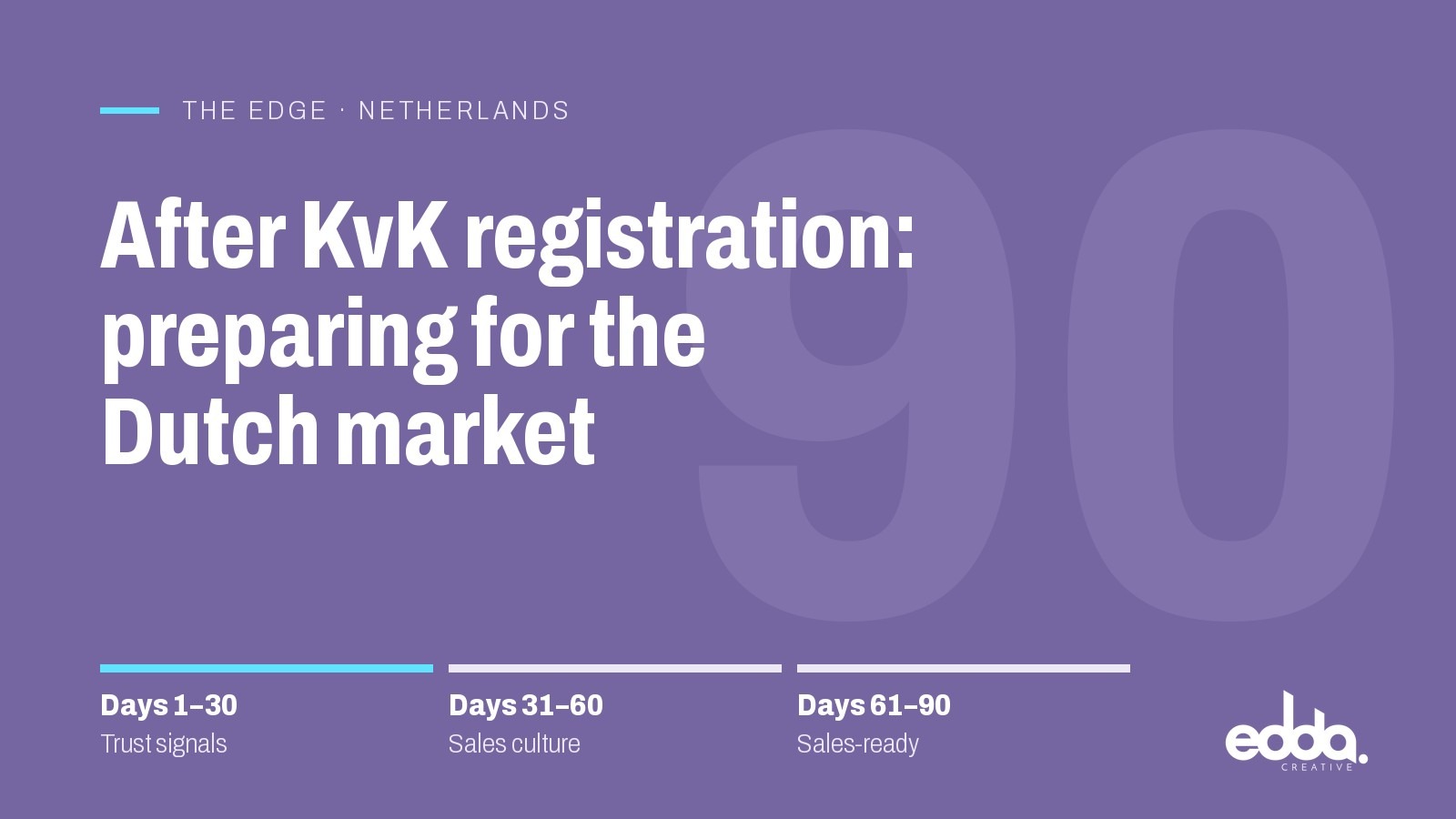
Days 1–30: the Dutch buyer’s trust checklist
A Dutch buyer who does not know you will check you online first. What they look for is quite specific:
- KvK and VAT numbers: visible on your website, email signature and invoices. Showing the KvK number on your website and correspondence is a legal requirement.
- A Dutch, or at least clear English, website: not a translation of your home-market site, but pages written around the Dutch customer’s questions.
- Local contact details: a Dutch address, a +31 phone number and a channel that answers quickly.
- Google Business Profile and a LinkedIn company page: being present where buyers and decision makers look.
- Payment and invoicing habits: prices in euros with VAT shown separately; SEPA bank transfers; 30-day terms are common in B2B; consumers expect iDEAL.
- References: one real customer story persuades more than ten generic claims.
Days 31–60: how selling works in the Netherlands
Relationship-driven selling, strong in many markets, takes a different shape here. Relationships still matter, but trust is built through consistency rather than words.
- Directness: the Dutch speak plainly and expect the same. Clear scope, dates and prices instead of vague promises.
- Prepared meetings: an agenda shared in advance, meetings that start and end on time, and a written summary afterwards.
- Shared decisions: purchases are usually approved by several people. The first person you meet may not decide; there is a team to convince.
- Transparent pricing: haggling is less common; the first offer is expected to be realistic and itemised.
- Public procurement: public tenders are published on TenderNed; if you target this market, prepare your documents early.
Days 61–90: getting sales-ready
At this stage the goal is not to be everywhere but to reach the right companies with the right preparation. Running sales conversations and building customer relationships is your company’s job; the steps below make that work easier.
- Ideal customer profile: do not spend on ads or fairs before sector, company size, region and decision-maker title are clear.
- Target list and personal outreach: short messages on LinkedIn and email, in Dutch where possible, each with a concrete reason to talk.
- Trade fairs and sector events: the right fair compresses months of introductions into three days. We were at WoTS in Utrecht this year.
- Local partners: accountants, trade associations and firms offering complementary services bring the warmest referrals.
- The first case story: write up the result with your first customer, with permission, straight away; it becomes your strongest sales tool.
The real first-year budget
Formation quotes usually cover only the notary, KvK, address and accounting. When you plan the first year, list these items separately too:
- Formation and admin: notary, KvK registration, registered address, accounting
- Local visibility: a Dutch website, Google Business Profile, LinkedIn, basic sales materials
- Sales and marketing: target list, content, advertising, trade fairs
- Travel and local meetings
- Time to the first invoice: plan your cash flow around it
We explain what drives marketing budgets in How much does marketing consultancy cost?
How Edda Creative works
We treat company formation and market entry as two parts of the same plan. While we coordinate formation with our legal and accounting partners, the same team handles market-entry strategy, brand, Dutch-language communication, sales materials and trade fair preparation. Sales conversations and customer relationships stay with you; we make sure you go into them with the right message, the right materials and good preparation. We work from Amsterdam and Ankara, in English, Dutch and Turkish. See this guide for questions to ask an advisor, and our business development and marketing consultancy page for market-entry support.
Want to talk through your Netherlands plan? Get in touch.
Frequently asked questions
What should I do first after setting up a company in the Netherlands?
Once the bank account, VAT number and bookkeeping are in place, prepare the trust signals a Dutch customer will look for: a website showing your KvK and VAT numbers, local contact details and a Google Business Profile.
How long does it take to start selling in the Netherlands?
It depends on the sector and sales cycle. In B2B, decisions involve several people, so a first order taking a few months is normal; plan your cash flow around the time to the first invoice.
Can I live in the Netherlands if I own a Dutch company?
No, owning a company does not by itself give a residence right. For Turkish nationals, a self-employed residence permit under the Ankara Agreement is assessed through a separate application.
Sources