8 min read
Dutch healthcare for expats: GP, referrals, the €385 deductible and out-of-hours care explained (2026)
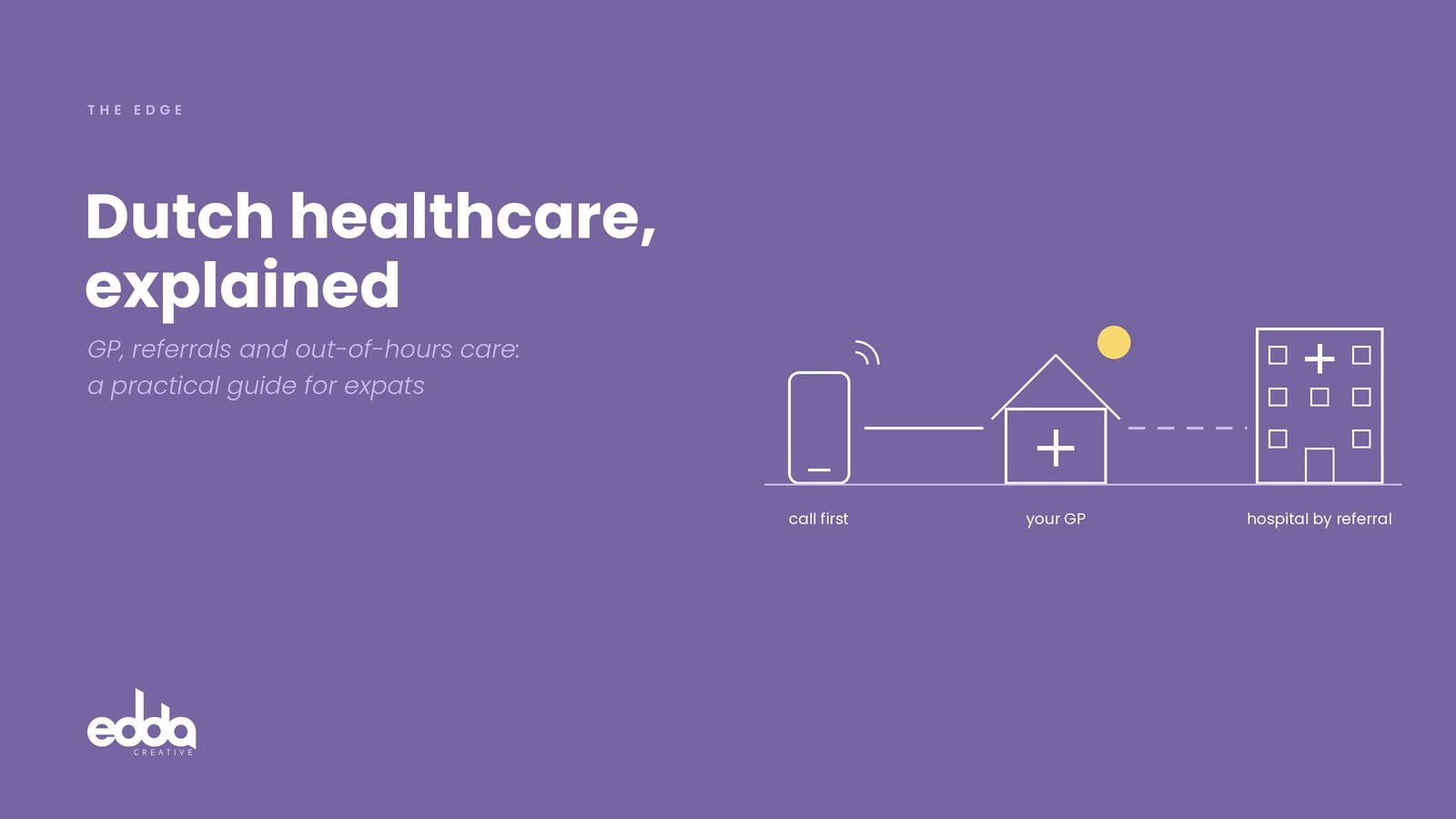
For most people who move to the Netherlands, the first real encounter with Dutch healthcare is a bad cold or a child with a fever, and that is when they discover the system works differently from home. You cannot book a specialist yourself, you phone before you go to a hospital at night, and what your insurance pays depends on the type of care. This guide brings together what newcomers, and companies relocating staff, ask most often, based on official Dutch sources.
This article is general information, not medical or insurance advice. Cover differs between policies, so check your own insurer’s terms. Information checked against official sources on 14 November 2026. In a life-threatening emergency, call 112 straight away.
At a glance: who, when, and who pays?
| Situation | Where to go first | Counts towards your deductible (eigen risico)? |
|---|---|---|
| Illness or complaint during the day | Your registered GP (huisarts) | No |
| Evening, night or weekend, urgent but not life-threatening | Phone the out-of-hours GP service (huisartsenpost) first | No |
| Hospital emergency department (SEH) | Usually via the huisartsenpost | Yes |
| Specialist or hospital care | With a GP referral (verwijzing) | Yes |
| Pregnancy | A midwife (verloskundige), directly | No |
| Physiotherapy, dietitian | Directly; reimbursement depends on your policy | Depends on policy |
| Life-threatening emergency | 112 | — |
1. Register with a GP first
The GP, or huisarts, is the front door of Dutch healthcare. Register with a practice near your home as soon as you move. You can usually choose your own GP, but a practice may turn you down if it is full or you live too far away. If you cannot find one, your health insurer can help (Rijksoverheid, in Dutch). Registration is not compulsory, but looking for a practice on the day you fall ill makes everything harder.
Remember that Dutch basic health insurance is compulsory for residents and must be taken out within four months of arrival (Government.nl). For the other first-year deadlines, see our first-year guide for expat managers.
2. Specialists need a referral
You cannot book a cardiologist, dermatologist or other specialist yourself. Your GP sees you first and gives a referral letter (verwijsbrief) when it is medically necessary. Without a referral you may have to pay for the treatment yourself, and you cannot claim it from your insurer afterwards (Rijksoverheid, in Dutch).
Some care needs no referral: physiotherapists, exercise therapists, dental hygienists, skin therapists, dietitians, occupational therapists, speech therapists and podiatrists. How much of it your insurance pays depends on your policy.
Many newcomers are also surprised that the GP does not prescribe something for every complaint. Dutch GPs work to national guidelines and, for many minor complaints, advise waiting, rest and a follow-up call if things get worse.
3. Evenings, nights and weekends: phone first
When your GP practice is closed and the situation is urgent but not life-threatening, do not go straight to hospital. Call the regional out-of-hours GP service (huisartsenpost) first. They assess you by phone and tell you whether to come in, wait for your own GP or go to the emergency department (SEH). If someone’s life is in danger, call 112 immediately (Rijksoverheid, in Dutch).
It also matters for your wallet: the huisartsenpost does not count towards your deductible, the emergency department does. Save the number of your local huisartsenpost in your phone in your first week.
4. Your deductible (eigen risico): €385
The compulsory deductible for adults is €385 in 2026 and 2027, according to the Dutch government. You pay the first €385 of covered care each year before your insurer starts paying. GP care including the huisartsenpost, midwifery and maternity care, and all care for children under 18 are exempt (Rijksoverheid, in Dutch).
Blood tests and X-rays requested by your GP, prescription medicines from the pharmacy, and specialist and hospital care do count. So the GP visit itself is free, but the tests that follow can come out of your own pocket early in the year.
5. Dental care and physiotherapy: check supplementary cover
Basic insurance covers a broad range of dental care for children under 18, including check-ups and fillings. From 18, only surgical dental care, X-rays and removable dentures are covered; routine check-ups are not (Rijksoverheid, in Dutch).
Physiotherapy is also not covered for most complaints. Even for conditions on the chronic list, you usually pay the first 20 sessions yourself (Rijksoverheid, in Dutch). That is why many people take out supplementary insurance (aanvullende verzekering) for dental care and physiotherapy. Annual limits and waiting periods differ by insurer, so read the terms before you buy.
6. Pregnancy starts with a midwife
When you find out you are pregnant, you can book directly with a midwife (verloskundige) without seeing your GP first; the midwife refers you to a gynaecologist if needed. Book maternity home care (kraamzorg) early: the national pregnancy leaflet from RIVM recommends doing it before week 16 (RIVM: Zwanger!, in Dutch).
Midwifery and maternity care do not count towards your deductible, but there is a statutory hourly contribution for maternity care at home: €5.70 per hour in 2026 (Rijksoverheid, in Dutch).
7. Mental health: start with your GP, watch the waiting times
Psychologists and psychiatrists are usually reached through your GP. For mild to moderate complaints, your GP may refer you to the practice’s own mental health nurse (POH-GGZ). Waiting times for specialist mental health care can be long. According to the Dutch government, if you have to wait more than 4 weeks for a first appointment, or more than 10 weeks after that first contact to start treatment, you can report it to your insurer, which must then offer an alternative or, if necessary, reimburse care from a non-contracted provider (Rijksoverheid, in Dutch).
8. Travelling home: what your Dutch insurance covers abroad
Within Europe, take your European Health Insurance Card (EHIC), which gives access to medically necessary care. The Netherlands also has agreements with a number of treaty countries, where you are entitled to care from that country’s basic package. Outside these arrangements, your insurer reimburses at most what the treatment would cost in the Netherlands, so a private clinic can leave you with a large bill, and repatriation is only covered by travel or supplementary insurance (Rijksoverheid, in Dutch).
Turkey is a good example of how this works in practice: the EHIC is not valid there, but under the social security agreement between the two countries you can receive urgent care in a state hospital with a 111 form issued via your insurer (Zilveren Kruis: 111 form). Before any trip, check with your insurer and travel insurer what is covered in your destination.
For companies relocating staff to the Netherlands
A large share of the questions new arrivals ask in their first weeks are about healthcare. Companies that relocate staff, or that are setting up a company in the Netherlands, make those first weeks much smoother by adding a short healthcare guide to their onboarding pack.
What does Edda Creative do?
Edda Creative is a business development, branding and digital marketing agency working from Amsterdam and Ankara with brands worldwide. We organise company formation in the Netherlands and the first six months of follow-up, and we produce the guides, presentations and corporate videos companies use to welcome new employees and partners. We do not give healthcare, insurance or immigration advice. Send a short email about your project to info@eddacreative.com.
Frequently asked questions
Can I see a specialist in the Netherlands without a GP referral?
Usually not. Specialist and hospital care require a GP referral. Without one, you may have to pay yourself and cannot claim the costs from your insurer afterwards.
What should I do if I fall ill at night?
If life is in danger, call 112. Otherwise, phone your regional out-of-hours GP service (huisartsenpost) first. They assess you by phone and refer you to the emergency department if needed. The huisartsenpost does not count towards your deductible; the emergency department does.
How much is the Dutch health insurance deductible in 2026?
€385 for adults in 2026 and 2027, according to the Dutch government. GP care, the out-of-hours GP service, midwifery, maternity care and care for children under 18 are exempt.
Are dental check-ups covered by basic insurance?
For children under 18, yes. From 18, routine dental check-ups are not in the basic package; you need supplementary insurance.
Does my Dutch insurance cover me when I travel home?
It depends on the country. In Europe, use your EHIC. In treaty countries such as Turkey, urgent care is available under the treaty (in Turkey with a 111 form). Elsewhere, your insurer pays at most the Dutch rate. Travel insurance is recommended for repatriation and higher private costs.
Does Edda Creative help with choosing health insurance?
No. We do not give healthcare, insurance or immigration advice. We organise company formation in the Netherlands and the first six months of follow-up, and we produce guides, presentations and videos companies use for their employees.
Sources (checked on 14 November 2026): Rijksoverheid: eigen risico · Rijksoverheid: referral letter · Rijksoverheid: out-of-hours GP and emergency care · Rijksoverheid: choosing a GP · Rijksoverheid: basic package · Rijksoverheid: statutory contributions · Rijksoverheid: dental costs · RIVM: Zwanger! · Rijksoverheid: waiting times · Rijksoverheid: care on holiday abroad · Zilveren Kruis: 111 form · Government.nl: health insurance (Dutch government pages are in Dutch.)