8 min read
GEO explained: how brands get found when AI does the searching (and buying)
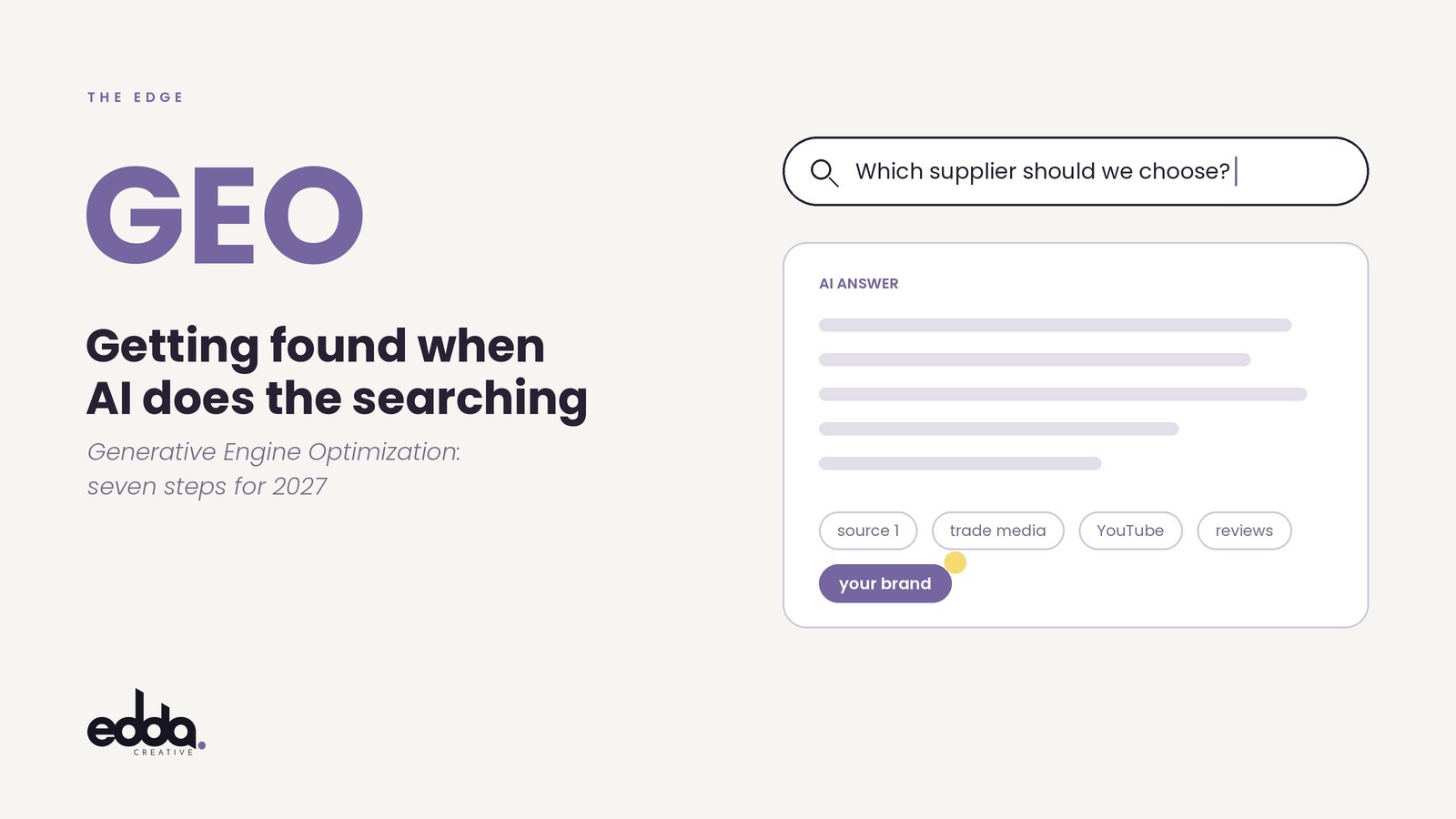
“Which agency makes the best corporate films?” “What do I need to set up a company in the Netherlands?” “Which supplier should I use for my trade fair stand?” More and more people now put questions like these to ChatGPT, Gemini or Google’s AI Overviews instead of a search box. The answer arrives as a single paragraph, and the brands named in that paragraph largely decide who gets the click.
Google’s AI features have spread fast: AI Mode is now available in more than 200 countries and territories (Google), and launched in Turkish in February 2026 (Google Türkiye). Marketers have a name for the new race for visibility: GEO, or Generative Engine Optimization.
This article explains what GEO is, what the research says, what Google officially recommends, and where “selling to AI” stands today. It ends with seven practical steps for brands heading into 2027.
What is GEO?
The term comes from a study by a team that included researchers from Princeton University. It was first published in 2023 and presented at the KDD 2024 conference (Aggarwal et al., GEO: Generative Engine Optimization). Classic SEO is about where a page ranks in search results. GEO asks a different question: when an AI writes an answer, does it use your content, mention your name and link to you as a source?
The researchers built a benchmark of 10,000 queries and tested different changes to content. The findings are striking:
- Adding quotations from credible people raised visibility in AI answers by about 41% on the metric they used.
- Adding statistics raised it by about 31%, and citing sources by about 27%.
- Keyword stuffing did not work; it performed worse than leaving the content unchanged.
- The most interesting result: a source ranked fifth in search results increased its visibility by 115% by citing sources. Smaller businesses that trail big brands in rankings have room to compete.
These results come from a research setting, so the same gains should not be expected in every sector or every AI tool. But the direction is clear: AI favours content that is clear, evidenced and easy to quote.
Why clicks are falling
A US study shows the scale of the shift. Pew Research Center analysed the real Google searches of 900 adults in March 2025 (Pew Research Center):
- About 18% of searches produced an AI summary. For searches phrased as questions, the figure was 60%.
- When a summary appeared, users clicked a traditional result 8% of the time, compared with 15% when there was none.
- Only about 1% clicked a link inside the summary itself.
- Wikipedia, YouTube and Reddit were among the sources cited most often in summaries.
In short, when the answer is given on the search page, users often never reach a website. That makes “are we named in the answer?” as important as “where do we rank?”
What Google says: no special trick
Google’s official guidance is clear: there are no additional requirements or special optimisations needed to appear in AI Overviews or AI Mode (Google Search Central). A page needs to be indexed and eligible to be shown in Search with a snippet. Google also says no AI-specific text files or special markup are required.
What it recommends is familiar: a crawlable site, good internal links, important content in text form, images and video that support the text, structured data that matches the visible page, and an up-to-date Business Profile and Merchant Center. GEO does not replace SEO; it builds on it. We made a similar case in SEO is not dead, search has simply changed.
What does “brands will sell to your AI” mean?
Shopping is the next step. AI assistants no longer just recommend products; in some markets they can start the purchase too:
- In November 2025 Google introduced agentic checkout in the US. A user tracks the price of a product, and when it drops, Google can complete the purchase with Google Pay after the user confirms. Google’s Shopping Graph holds more than 50 billion product listings (Google).
- In January 2026 Google announced the Universal Commerce Protocol (UCP), an open standard built with Shopify, Etsy, Wayfair, Target and Walmart. Retailers remain the merchant of record (Google).
- In March 2026 OpenAI updated shopping in ChatGPT: merchants share product data through the Agentic Commerce Protocol, and purchases now happen on the merchant’s own checkout (OpenAI).
Most of these features are US-only for now, and regulators are watching closely: in December 2025 the European Commission opened an antitrust investigation into how Google uses publishers’ content for AI Overviews and AI Mode (European Commission). Still, the lesson applies to any brand selling across borders: an AI can only recommend a product if it can read accurate, current information about it. A product with missing prices, stock, specifications or delivery details does not make the shortlist.
PR for AI: how others describe you
When an AI writes about a brand, it does not only look at the brand’s own website. It also draws on industry news, video platforms, forums, directories and customer reviews, which is why Wikipedia, YouTube and Reddit stand out in Pew’s data. GEO therefore has two sides:
- Your own content: pages that describe your services, products and expertise clearly, with evidence and a question-and-answer structure.
- Third-party sources: everything that describes you from the outside. Coverage in trade media, your entry in trade fair catalogues, partner reference pages, your YouTube videos and genuine customer reviews.
In a sense, this is public relations for AI. Just as it matters what journalists know about you, it matters what the sources an AI reads say about you, and whether they agree.
Seven steps for brands
- Ask the AI first. Put the questions your customers would ask to ChatGPT, Gemini and Google’s AI Mode, in every language you sell in. Are you mentioned? Is the information correct? Repeat this every quarter and keep notes.
- Keep the technical basics solid. Make sure your site can be crawled and is indexed. Do not hide important information inside images or PDFs; write it as text.
- Write content that answers questions directly. Use headings that mirror real customer questions, give the clear answer in the first paragraph, cite your numbers and name your experts.
- Keep your details consistent everywhere. Your company name, address, services and contact details should match on your website, Business Profile, LinkedIn and industry directories. Conflicting information can lead an AI to describe you wrongly.
- Invest in third-party visibility. Appear in trade media, complete your trade fair catalogue entries, and ask satisfied customers for genuine reviews. Fake reviews and mass-produced content do more harm than good.
- Do not neglect video. YouTube is among the platforms most often cited in AI summaries. Give your videos descriptive titles, descriptions and captions so their content can also be read as text.
- Measure. Google Analytics 4 can show traffic from AI assistants as a separate channel. On our own site, this channel brought 26 sessions in the last 28 days: small, but worth watching.
How your team uses AI tools is part of the picture too. We gathered what the research says in our article on AI and curiosity.
For the wider picture of how AI and search are changing marketing, see our marketing trends for 2027.
How Edda Creative works
Edda Creative supports brands with strategy and business development consultancy, digital marketing, content, video and communication planning. For GEO, that means sharpening how your brand describes itself, restructuring your website content around real questions, aligning video and trade fair materials around the same message, and measuring results regularly. Nobody can guarantee a place in an AI answer, and we do not promise one. To tell us what you need, send a short email to info@eddacreative.com.
Frequently asked questions
What is GEO?
GEO (Generative Engine Optimization) is the work of making content more likely to be used, mentioned and cited as a source in the answers of generative AI tools such as ChatGPT, Gemini and Google’s AI Overviews.
Is GEO replacing SEO?
No. According to Google, a page only needs to be indexed and eligible to appear in Search to be shown in its AI features; there are no extra requirements. GEO is a layer built on top of good SEO.
Do I need a special file or code for AI?
Google says no AI-specific text files or special markup are needed for AI Overviews and AI Mode. Other AI companies may work differently; the basic rule is that important information should be on the page as text.
Do AI assistants actually buy things?
In some markets, yes. In the US, Google can buy a product with Google Pay once its price drops, after the user confirms. ChatGPT shows products and sends the purchase to the merchant’s own checkout. These features are mainly available in the US for now.
How long does GEO take to show results?
There is no fixed timeline, and no method guarantees a place in an AI answer. The best approach is to ask the same questions regularly, record the results and improve your content accordingly.
Sources (checked on 13 November 2026): Aggarwal et al., GEO: Generative Engine Optimization (KDD 2024) · Pew Research Center (22 July 2025) · Google Search Central: AI features and your website · Google: AI Mode expands to more languages and countries (8 October 2025) · Google Türkiye: AI Mode and AI Overviews in Türkiye (18 February 2026) · European Commission (9 December 2025) · Google: agentic checkout (13 November 2025) · Google: NRF 2026, Universal Commerce Protocol (11 January 2026) · OpenAI: Powering product discovery in ChatGPT (24 March 2026)