6 min read
Microsoft 365 global outage: what happened and six lessons for organisations
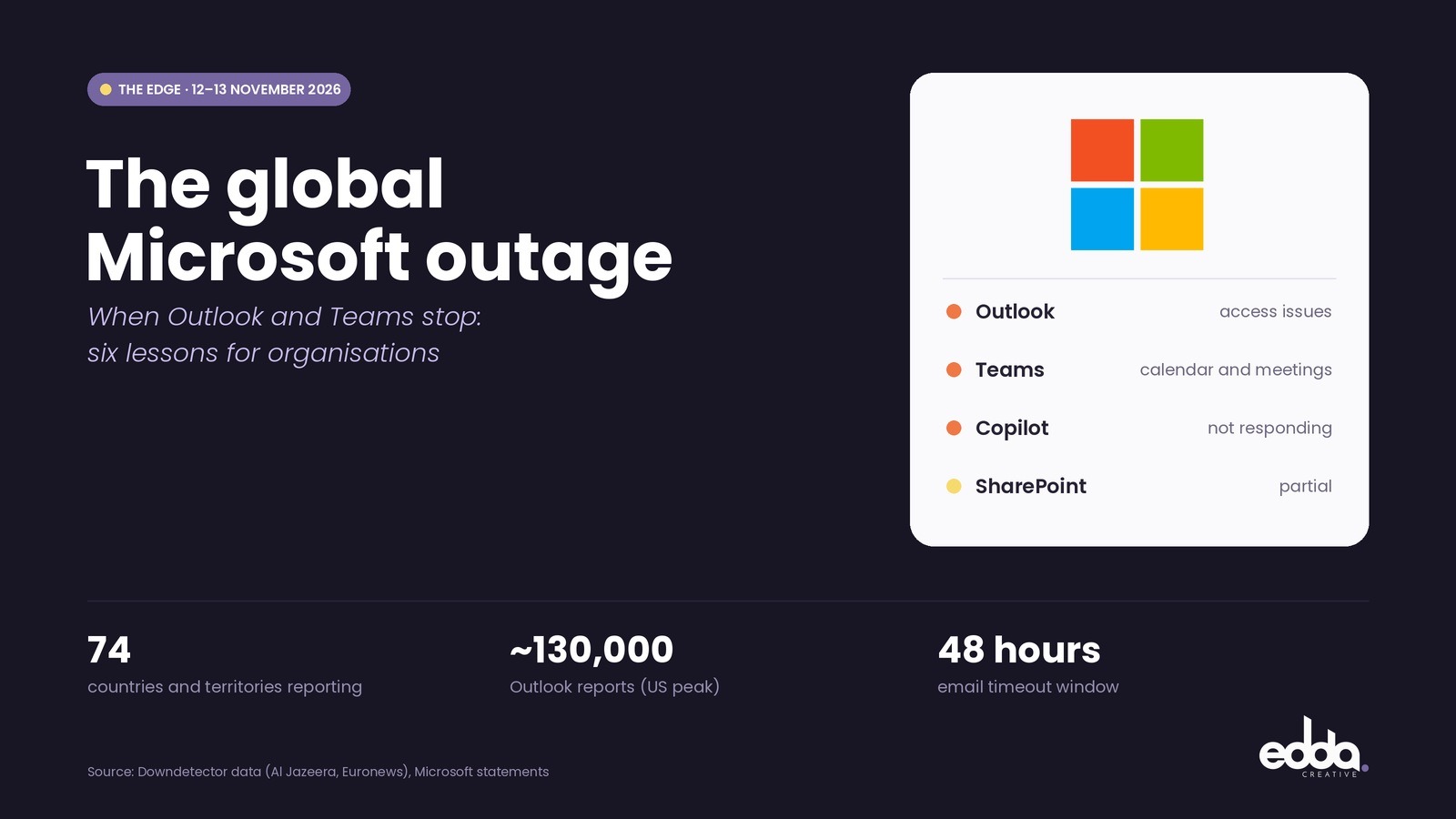
On the afternoon of Thursday 12 November 2026, users around the world started reporting that they could not get into Outlook. Within an hour, the outage tracker Downdetector had logged reports from 74 countries and territories (Al Jazeera). The disruption spread to Teams, Copilot and large parts of Microsoft 365, and ran into the next day.
Here is what happened, what Microsoft has said so far, and what organisations whose email, calendars and meetings depend on a single cloud provider can take from it. The information is current as of 13 November 2026.
What happened
- Start: problems began around 16:00 GMT on 12 November (Al Jazeera).
- Scale: Downdetector reports for Outlook in the United States peaked at around 130,000 (Euronews). On the morning of 13 November there were still at least 43,000 reports from 72 countries (Al Jazeera). These are user reports, not a count of everyone affected.
- Services: Outlook and Exchange Online were hit hardest, with mailboxes unreachable and email delayed. Microsoft’s list of affected services also included calendar and meeting scheduling in Teams, SharePoint features that depend on Exchange, Microsoft 365 Copilot, Defender, Planner, To Do and Intune.
- Organisations: government systems in Singapore and Japan, the Supreme Court of the Philippines and the Australian Federal Police were among those affected (Al Jazeera). In the Netherlands, many municipalities including Amsterdam and The Hague, five provincial governments and the House of Representatives could not send email (iBestuur). In the UK, schools, banks and hospitals reported disruption (Tom’s Guide).
What Microsoft has said
Microsoft shared updates through its Microsoft 365 Status account and the service health dashboard (Microsoft 365 Status). According to its statements:
- It first reported elevated load on part of its infrastructure across multiple regions. It later said the load was not driven by an increase in traffic, but by a large number of servers becoming unexpectedly unavailable and shifting load onto the remaining infrastructure (Tom’s Guide).
- The issue was initially thought to affect the Americas. Microsoft later said it could affect users in any region (Tom’s Guide).
- A process on the affected servers responsible for establishing secure connections became overwhelmed, leaving servers unable to process requests. Microsoft first began rolling back a recent network configuration change whose timing matched the start of the impact (Al Jazeera). On the evening of 13 November it linked the incident to an issue during an earlier network capacity upgrade, which surfaced after a recent network change (TechRadar).
- Microsoft said it had found no evidence of malicious activity (Al Jazeera). On 13 November it added that this was a technical issue not related to cyber activity or AI agents (TechRadar).
- To protect delayed messages, Microsoft extended the email timeout window to 48 hours. According to Dutch broadcaster NOS, this does not apply to messages sent from other providers’ servers, such as Gmail (NOS).
On the evening of 13 November, Microsoft said it had addressed the underlying issue and was still restoring service for the remaining customers and regions; some users may see intermittent problems or delayed email for a while longer (TechRadar). The company said it will publish a full Post-Incident Report once its review is complete.
Six lessons for organisations
Fixing the outage is Microsoft’s job. Whether a company can keep talking to its customers, staff and partners while it lasts depends largely on what it prepared beforehand. Six lessons:
- Agree on a second channel. When email and Teams fail at the same time, everyone should already know where to go: a phone tree, SMS, a messaging group, or a backup email address with a different provider. Set it up today, not during the incident.
- Tell your customers first. Do not let customers find out through unanswered emails. A short notice on your website, a post on your social channels and an up-to-date phone number on your Google Business Profile take minutes.
- Pause scheduled campaigns. Newsletters, automated follow-up flows and ads that say “email us” can backfire while email is down. Keep a checklist that lets you pause them all at once.
- Confirm important messages another way. Quotes, orders, payments and event registrations are time-sensitive. Confirm them by phone or another channel; the 48-hour timeout extension may not cover messages from external servers.
- Don’t improvise fixes; follow the official source. If the problem sits with the provider, reinstalling software or changing account settings will not help. Follow Microsoft’s official service health channels, and be alert to phishing emails asking you to “verify your account” during the disruption.
- Write down what happened. How long were you affected, which work stopped, which customers waited? Record it, review your service level agreement (SLA) with your IT team or licensing partner, and read Microsoft’s Post-Incident Report. It is also a good moment to review how much of your business depends on one provider.
The fact that AI assistants such as Copilot were among the affected services is a reminder in itself. As teams hand more everyday work to these tools, the plan for when a tool stops working becomes part of the job. We shared five checks for AI-assisted work in our article on PwC’s critical thinking programme.
How Edda Creative works
Edda Creative supports brands with strategy and business development consultancy, digital marketing, content and communication planning. Preparing the messages and channel plan you will use on your website, social media and in customer communication during a disruption is part of that work. For technical infrastructure and IT security, we recommend working with your own IT team or provider. To tell us what your team needs, send a short email to info@eddacreative.com.
This article is for general information only and is not IT, legal or contractual advice. It reflects the situation as of 13 November 2026; we will update it when Microsoft publishes its Post-Incident Report.
Frequently asked questions
When did the Microsoft outage start?
Problems began around 16:00 GMT on Thursday 12 November 2026 and continued into 13 November.
Which services were affected?
Outlook and Exchange Online were hit hardest. Microsoft’s list also included calendar and meeting scheduling in Teams, Microsoft 365 Copilot, SharePoint features that depend on Exchange, Defender, Planner, To Do and Intune.
Was it a cyberattack?
Microsoft said it has no evidence of malicious activity. On 13 November it described it as a technical issue not related to cyber activity, linked to a problem during an earlier network capacity upgrade. More detail is expected in its Post-Incident Report.
Were emails sent during the outage lost?
Microsoft extended the email timeout window to 48 hours to protect delayed messages. This may not cover messages sent from other providers’ servers, so it is worth confirming important correspondence another way.
How can organisations prepare for an outage like this?
By agreeing on a second communication channel, preparing ready-made messages to inform customers, keeping a checklist to pause scheduled campaigns quickly, and recording the impact afterwards.
Sources (checked on 13 November 2026): Al Jazeera: Microsoft hit by global outages (13 November 2026) · NOS: Ook in Nederland veel problemen door wereldwijde storing Microsoft (13 November 2026) · iBestuur: Wereldwijde storing bij Microsoft · Euronews (12 November 2026) · Tom’s Guide: live updates · TechRadar: live updates · Microsoft 365 Status (X)