7 min read
The new health economy: what AI and digital health change for health brands
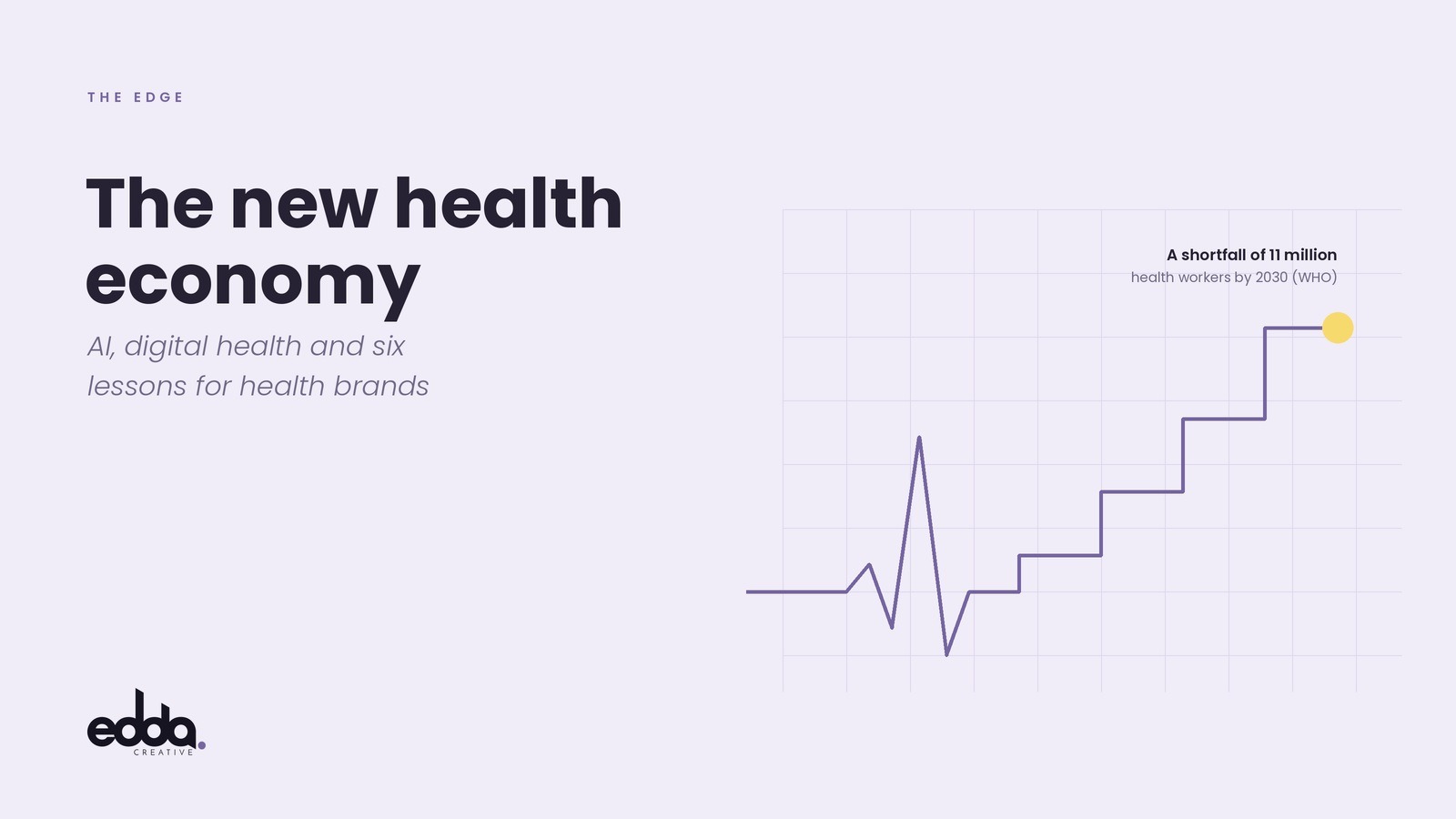
The economics of health care are shifting. The World Health Organization projects a global shortfall of 11 million health workers by 2030 (WHO). Demand keeps rising while the number of doctors, nurses and technicians does not keep pace. AI and digital health are among the most discussed ways to close that gap. But when you look at where investment, regulation and trust are actually moving, the picture is more nuanced than the marketing suggests.
This article looks at where AI is being used in health today, which rules take effect in Europe and when, and what health technology companies, hospital groups and suppliers selling into regulated markets should keep in mind when they communicate.
What is the new health economy?
In short: value in health care no longer comes only from buildings, devices and staff, but also from how data and software are used. Appointments, reporting, imaging and medication tracking are all going digital, and the data those processes generate is becoming the raw material for new services.
The European Commission puts numbers on it. It expects easier access to health data under the European Health Data Space (EHDS) to save around €11 billion over the next decade and to grow the digital health sector by 20–30% (European Commission).
Where AI is being used today
In November 2025, WHO/Europe published a survey answered by 50 of the 53 countries in its region (WHO/Europe). The headline findings:
- Diagnostics: 32 countries (64%) already use AI-assisted diagnostics, especially in imaging.
- Patient engagement: half of the countries have introduced AI chatbots for patient support.
- Strategy: only 4 countries (8%) have a dedicated national AI strategy for health; another 7 are developing one.
- Barriers: 86% of countries cite legal uncertainty and 78% financial constraints as major obstacles. Fewer than one in ten countries have liability standards for AI in health.
- Motivations: improving patient care (98%), reducing workforce pressure (92%) and increasing efficiency (90%).
The OECD’s March 2026 report paints a similar picture across its members: AI is already widely used for administrative tasks, but large-scale clinical deployment is still limited. The barriers it lists are fragmented data foundations, regulatory uncertainty, and gaps in governance and workforce capacity (OECD).
Put together, the pattern is clear. The money and the early wins sit in the less glamorous places: documentation, scheduling, triage and imaging support. The fully automated clinic is still some way off, and buyers know it.
The European rulebook and its dates
Europe has the most detailed rulebook for AI in health, and it applies to any company selling into the EU, wherever it is based. The key dates:
- 2 August 2026: the AI Act’s transparency rules started to apply. AI systems must be designed so that people know they are interacting with AI (European Commission). For patient-facing chatbots, that is a communication question as much as a legal one.
- March 2027: the Commission is due to adopt the implementing acts that set out the detailed rules for the EHDS (European Commission).
- 2 December 2027: AI Act rules for stand-alone high-risk AI systems (Annex III) start to apply (European Commission).
- 2 August 2028: rules for high-risk AI embedded in products such as medical devices (Annex I) start to apply. Both dates were pushed back by the “Digital Omnibus” amendment that entered into force in July 2026 (European Commission).
- March 2029: patient summaries and ePrescriptions should be exchangeable in all EU countries, and rules on the secondary use of electronic health record data begin to apply (European Commission).
- March 2031: medical images, lab results and hospital discharge reports follow (European Commission).
- March 2035: third countries and international organisations can apply to join HealthData@EU for secondary use (European Commission).
One more point that matters for marketers: under the EHDS, secondary use of health data requires a permit from a health data access body and is limited to defined purposes. Marketing is explicitly prohibited (European Commission).
Six lessons for health technology communication
In health care, AI is no longer just a product feature. It is a question of trust. Whether you run a hospital group, build medical devices or sell health software, these six points help:
- Lead with the problem, not the technology. “AI-powered” says very little on its own. Are waiting times shorter, is reporting faster, are fewer findings missed? Say what you measured.
- Keep claims proportionate. If your product does not diagnose, do not say it does. If it supports decisions, say exactly that. Medical device rules and AI rules create obligations that reach into marketing copy too.
- Explain where the data goes. Patients and clinicians want to know where data is processed and who can see it. Prepare a plain-language answer that holds up under GDPR and the privacy laws of your other markets.
- Let your chatbot introduce itself. If an AI assistant talks to patients in the EU, people need to know it is AI. Design that moment as a trust signal, not a disclaimer.
- Build two languages for two audiences. Clinicians and procurement teams ask about evidence, integration and liability; patients ask what is in it for them. One brochure rarely serves both.
- Make the evidence visible. Clinical studies, certifications, pilot results and reference sites do more work than adjectives like “innovative”.
We shared five questions for checking AI-assisted content in our article on PwC’s critical thinking programme. Health communication is one of the places where that kind of check matters most.
On the trade fair calendar
MEDICA, one of the world’s largest medical trade fairs, takes place in Düsseldorf from 16 to 19 November 2026. One of its new main areas is dedicated to digital medicine, data and artificial intelligence (MEDICA). For exhibitors and visitors in that space, a clear message matters more than ever. Our trade fair preparation checklist can help with the groundwork.
How Edda Creative works
Edda Creative supports brands across sectors, including health and technology, with strategy and business development consultancy, branding, digital marketing, content and trade fair preparation. Making a complex product clear to clinicians, procurement teams and patients alike is a large part of what we do. You run the sales and the customer relationships; we prepare the message, the materials and the presentation. To tell us about your project, send a short email to info@eddacreative.com.
This article is for general information only and is not medical, legal or regulatory advice. Please consult your own specialists about the regulatory status of your product.
Update (14 November 2026): We look at the consumer and brand side of the same shift in the four layers of the new health economy: sensor, data aggregation, interpretation and revenue.
Frequently asked questions
What is the new health economy?
A shorthand for the shift in which value in health care comes not only from buildings, devices and staff, but also from how data and software are used. AI, electronic health records and remote services sit at the centre of it.
How widely is AI used in European health systems?
According to a WHO/Europe survey of 50 countries, 64% use AI-assisted diagnostics and half use AI chatbots for patient support. Only 8% have a dedicated national AI strategy for health.
When does the EU AI Act apply to medical devices?
Following the July 2026 amendment, rules for high-risk AI embedded in products such as medical devices apply from 2 August 2028. For stand-alone high-risk AI systems, the date is 2 December 2027.
When does the European Health Data Space take effect?
The regulation entered into force on 26 March 2025. Patient summaries and ePrescriptions should be exchangeable across the EU by March 2029, and medical images, lab results and discharge reports by March 2031.
How should a health brand use the phrase “AI-powered”?
By describing what the product does and what result it delivers, in measured and verifiable terms. A product that does not diagnose should not claim to, and if it supports clinical decisions, that should be stated clearly.
Sources (checked on 11 November 2026): WHO: Health workforce · WHO/Europe: Artificial Intelligence in Health, State of Readiness (19 November 2025) · OECD: Scaling Artificial Intelligence in Health (March 2026) · European Commission: European Health Data Space Regulation · European Commission: AI Omnibus enters into force (27 July 2026) · European Commission: Quick facts, transparency rules · MEDICA 2026