7 min read
The four layers of the new health economy: sensor, data, interpretation and revenue
For a long time, healthcare was a visit economy. Something hurt, you saw a doctor, a pharmacist or a clinic, you bought a product or a service, and the relationship ended there. In the new health economy it does not end. A watch on the wrist, a ring on the finger or an app on the phone measures every day; that data is collected in one place, software interprets it, and value moves from the one-off sale to a continuous relationship.
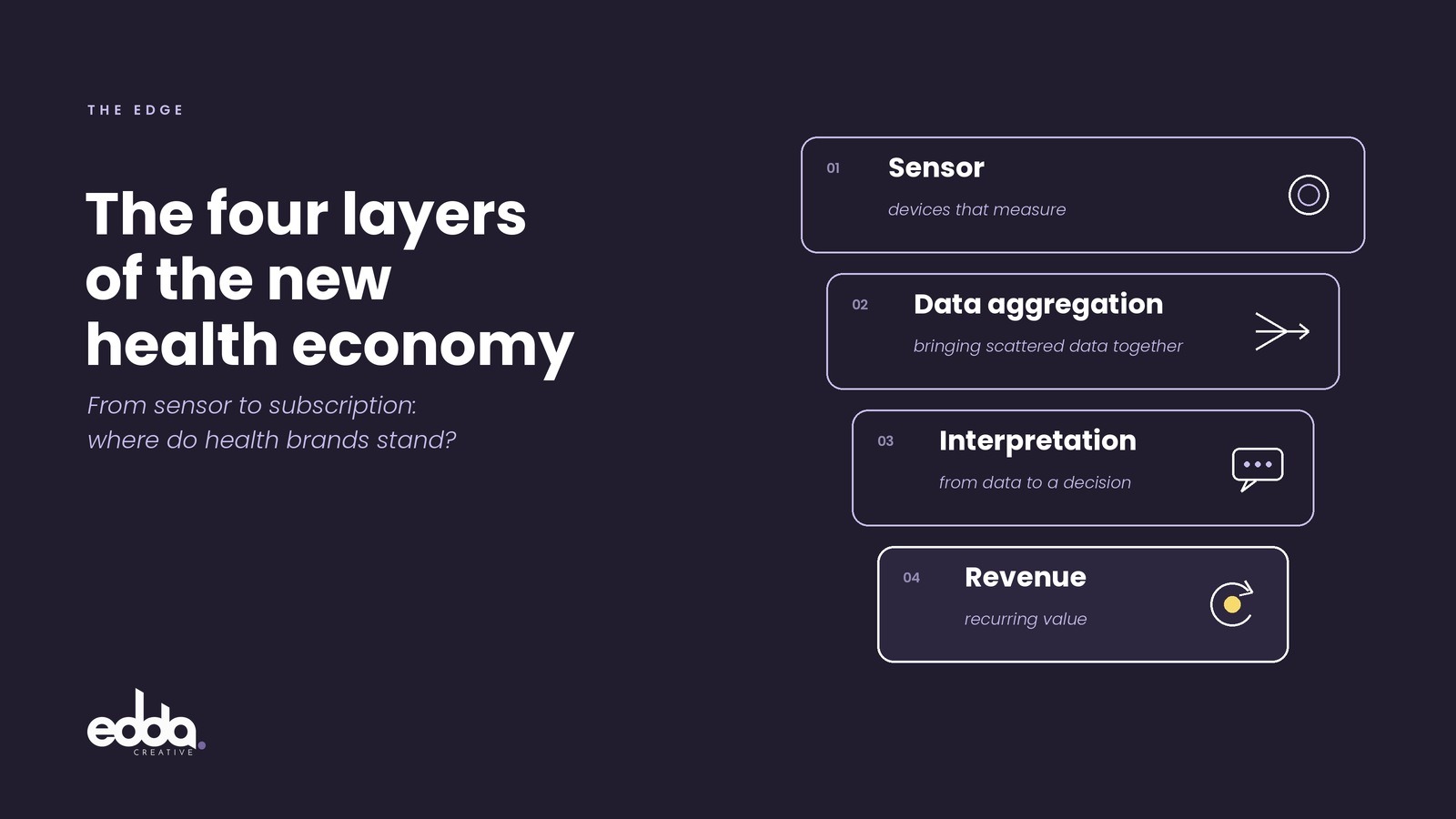
Thinking about this shift in four layers makes it easier to see where each brand stands: sensor, data aggregation, interpretation and revenue. Below we illustrate each layer with what the companies themselves have published, and explain what it means for health brands, from pharmacies and clinics to health-tech start-ups, wherever they operate.
This article is general information, not medical, legal or regulatory advice. Company information checked against official company pages on 14 November 2026.
At a glance: the four layers
| Layer | What it does | Example | The question for brands |
|---|---|---|---|
| 1. Sensor | Measures sleep, heart rate, movement, temperature | Smart rings and watches | What do you measure, and how reliably? |
| 2. Data aggregation | Brings scattered data together | Health apps on the phone | Whose platform does your data live on? |
| 3. Interpretation | Turns data into a meaningful decision | AI assistants | Which question do you answer for the user? |
| 4. Revenue | Creates economic value from an ongoing relationship | Memberships and subscriptions | Why would people come back every month? |
1. Sensor: the devices that measure
The first layer is measurement itself. Smart watches and rings track sleep, heart rate, movement and body temperature around the clock. Oura, for example, says on its website that it has more than 5 million members (Oura). But a sensor alone is not a business model: many devices measure the same signals and hardware quickly converges. The difference appears in what the measurement becomes in the next layers.
2. Data aggregation: bringing scattered data together
One person’s sleep data may sit in a ring, their steps on their phone, their meals in a diet app and their lab results in a hospital system. The platform that brings this together is the one that sees the whole picture. Apple’s Health app is a clear example: according to Apple, downloaded health records are encrypted in the device’s HealthKit database, and when users consent they decide which data is shared with which third-party app (Apple).
The lesson for brands: owning the aggregation layer is hard and expensive. For most, the realistic question is not “can we become a platform?” but “how do we connect to existing platforms in a trustworthy way, and how do we explain that to users?”
3. Interpretation: from data to a meaningful decision
Raw data means little to most people. The value lies in answering “what does this mean, and what should I do?”, and this layer is moving quickly to AI. On 7 January 2026, OpenAI introduced ChatGPT Health, a dedicated space for health and wellness within ChatGPT. According to the company, over 230 million people globally ask ChatGPT health and wellness questions every week (OpenAI).
ChatGPT Health can connect to apps such as Apple Health, Function, MyFitnessPal, Weight Watchers, AllTrails, Instacart and Peloton, with medical records connected through b.well in the US. OpenAI says conversations in Health are not used to train its foundation models and that the service is not intended for diagnosis or treatment. At launch it was available to users outside the European Economic Area, Switzerland and the UK (OpenAI).
That matters for health brands: users can now ask an AI assistant about your product before they ever reach your website. Whether the assistant describes you accurately depends on clear, trustworthy information being available online. We cover this in our article on GEO.
4. Revenue: economic value from an ongoing relationship
The last layer explains why the first three matter: value shifts from a single sale to a continuous relationship. Oura is a clear example. New members get one complimentary month; after that, membership costs €5.99 a month in the EU or $5.99 in the US. Without a membership, the app shows only the three daily scores for Readiness, Activity and Sleep (Oura). The device opens the door; the lasting relationship and the recurring revenue are built in the interpretation layer.
Pharmacies, clinics, supplement and personal care brands face the same question: why would a customer stay in touch after the purchase? Reminders, follow-up, personalised advice, regular content and a well-designed membership experience are the answers.
Trust: health data is not ordinary data
All four layers rest on one thing: trust. In the EU, the GDPR treats health data as a special category of personal data (GDPR, Art. 9), and Turkey’s data protection law does the same (KVKK, Art. 6). Under the EU’s European Health Data Space (EHDS), secondary use of health data is limited to permitted purposes, and marketing is explicitly prohibited (European Commission). Other markets have their own rules, so check the law where you sell.
For communication, the implication is simple: explain in plain language, and somewhere visible, what you measure, where the data is stored, who can access it and what you do not do with it. Avoid medical claims; if your product does not diagnose, say so. In health, trust wins more business than the cleverest marketing line.
Five questions for health brands
- Which layer are you in? Do you measure, aggregate, interpret, or manage the relationship?
- Which platforms do you connect to? Your users’ data already lives somewhere; how does your product fit in?
- Which question do you answer? Not “more data”, but “what should I do today?”
- Why would they come back? Is the communication plan for the three months after the first sale ready?
- How do you explain your data use? Is your privacy copy written for users, or only for lawyers?
We looked at the impact of AI on hospitals and health systems in our article on the new health economy; this piece looks at the consumer and brand side of the same shift.
What does Edda Creative do?
Edda Creative is a business development, branding and digital marketing agency working from Amsterdam and Ankara with brands worldwide. For health and wellbeing brands, we build positioning and market entry strategy, brand identity and communication design, and digital marketing and content. We do not give medical, legal or regulatory advice, and we do not find clients for you. Send a short email about your project to info@eddacreative.com.
Frequently asked questions
What are the four layers of the new health economy?
Sensor (devices that measure), data aggregation (bringing scattered data together), interpretation (turning data into a meaningful decision) and revenue (creating economic value from an ongoing relationship). Value is moving from one-off sales to continuous relationships.
What is ChatGPT Health, and is it available in Europe?
A dedicated space for health and wellness within ChatGPT, introduced by OpenAI on 7 January 2026. At launch it was available to users outside the European Economic Area, Switzerland and the UK, with medical record connections and some apps limited to the US. OpenAI says it is not intended for diagnosis or treatment.
Can health data be used for targeted advertising?
Health data is a special category of personal data under the GDPR and subject to strict rules. Under the EU’s EHDS, marketing is explicitly excluded as a purpose for secondary use of health data. Always check with your legal adviser for your own situation and markets.
How can a small health brand benefit from this shift?
Rather than trying to build all four layers, focus on the layer where you are strong, connect to existing platforms in a trustworthy way and design the relationship after the first sale: reminders, follow-up, content and a clear explanation of how you use data.
Does Edda Creative work with health brands?
Yes. We support health and wellbeing brands worldwide with positioning, brand identity, communication and digital marketing. We do not give medical, legal or regulatory advice.
Sources (checked on 14 November 2026): OpenAI: Introducing ChatGPT Health (7 January 2026) · Oura: Oura Membership · Oura: Membership · Apple: privacy and security of health records · GDPR (EU) 2016/679 · Turkey: Law No. 6698 (KVKK) · European Commission: EHDS