5 min read
PwC to certify 85,000+ people in critical thinking: why judgment matters more in the AI era
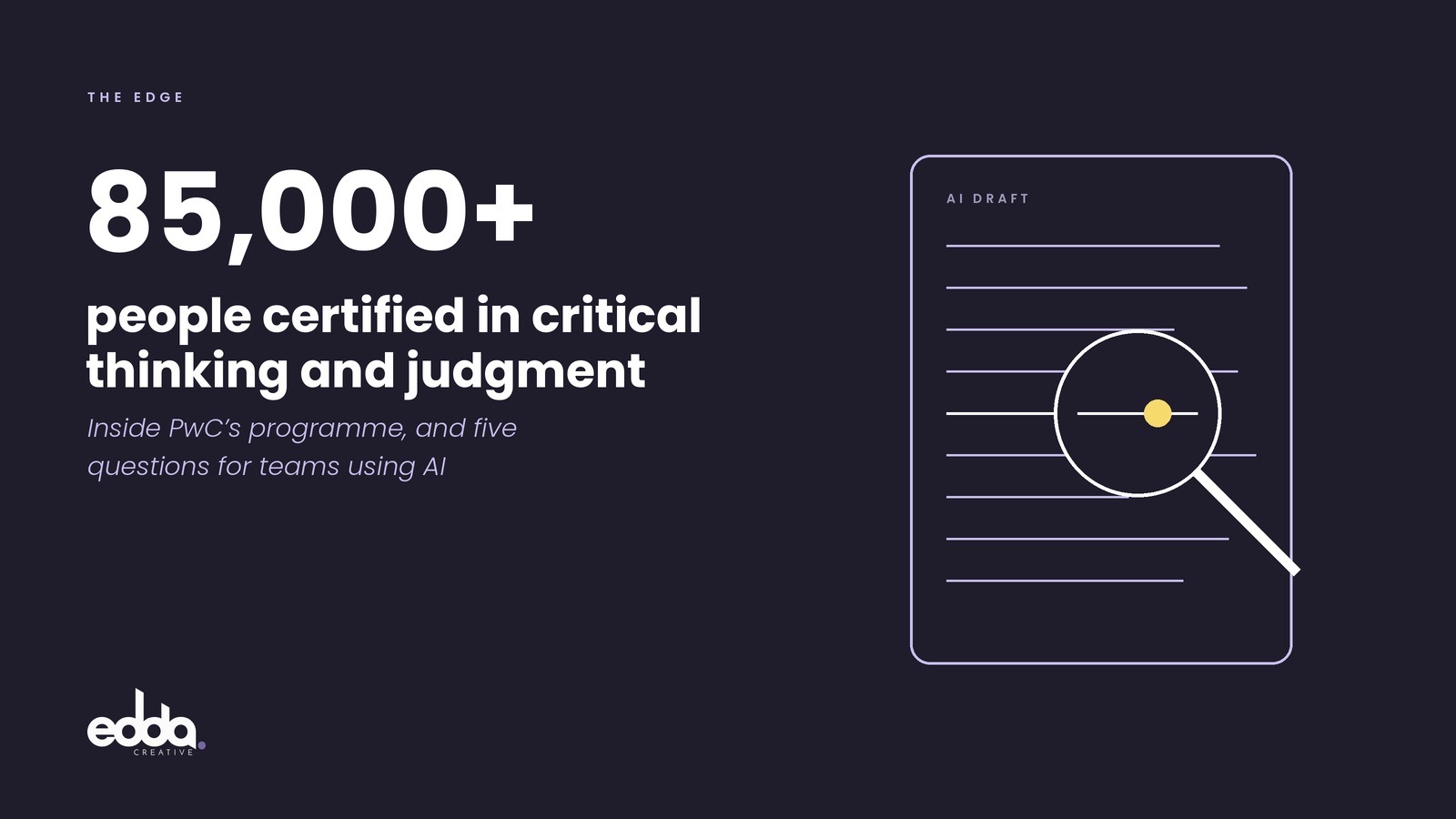
On 9 November 2026, PwC US announced that more than 85,000 of its partners and employees will earn a certificate in critical thinking and judgment (PwC). The reasoning is simple: AI is taking over a growing share of research, writing and analysis. The judgment that people used to build by doing that work is becoming a skill that has to be practised on purpose.
Here is what the programme involves, why it is arriving now, and what any organisation using AI can take from it, whatever its size or market.
What PwC announced
The programme is called the Critical Thinking & Judgment Certificate. According to PwC (PwC):
- Who: more than 85,000 partners and employees across PwC’s US and Mexico offices and its Acceleration Centers.
- When: the rollout starts in December 2026, with completion targeted for June 2027.
- Based on: a framework PwC developed itself, which it is validating with academic experts, including professors affiliated with the Wharton School and Harvard University.
- Universities: from early 2027, PwC will make the framework available to any interested university and fund selected universities to develop introductory course materials.
How the programme works
PwC describes five building blocks:
- A diagnostic scenario that shows each participant’s thinking preferences, strengths and growth areas.
- Training in the framework and applying it to practical situations. The framework focuses on establishing context in complex decisions, challenging information and assumptions, and communicating recommendations clearly and accountably.
- Masterclass-style videos with PwC leaders and external thought leaders.
- Personalised simulations tied to each participant’s own work.
- On-the-job toolkits, team collaboration scenarios and everyday routines to make the skills stick.
Why now?
PwC’s own explanation is that professionals have traditionally built judgment by doing the work: researching, analysing, questioning assumptions and learning from mistakes. As AI takes on more of that foundational work, the natural route by which junior people develop judgment gets narrower (PwC).
The wider data points the same way. In the World Economic Forum’s Future of Jobs Report 2025, seven in ten employers consider analytical thinking an essential core skill, and employers expect 39% of workers’ core skills to change by 2030 (WEF). A study of 319 knowledge workers by Microsoft Research and Carnegie Mellon University found that higher confidence in generative AI was associated with less critical thinking, while higher self-confidence was associated with more (CHI 2025). We looked at this and related research in our article on AI and curiosity.
What other organisations can take from it
Most companies will not run an 85,000-person certification. But the underlying problem is the same in a ten-person marketing team, a regional sales office or a start-up preparing for its first trade fair abroad. AI drafts the market summary, the competitor comparison or the press release in minutes, and an outdated figure or a wrong assumption about a market can travel just as fast.
A simple starting point is to ask five questions of every important piece of AI-assisted work:
- What is the source? Which official or primary source is this based on, and has someone opened it?
- How current is it? Are the figures, dates and rules up to date?
- What is being assumed? Which market, customer or condition does the text take for granted, and does it fit ours?
- What is missing? Has a counter-argument, a risk or an exception been left out?
- Who signs it off? Who stands behind this output and can explain the reasoning if asked?
The second lesson is for managers. If AI now does the apprentice work, teams need other ways for junior colleagues to build judgment: reviewing drafts together, asking people to write down the reasoning behind a decision, or generating two different answers to the same question and comparing them.
It is also worth watching the university side. If more institutions adopt frameworks like PwC’s, graduates may arrive with a shared vocabulary for judgment, and employers who already have one will find it easier to build on.
Update (11 November 2026): Health care is one of the most sensitive areas for AI. Our article on the new health economy, based on WHO, OECD and EU data, sets out six communication lessons for health brands.
Update (18 November 2026): For the marketing side of critical thinking, read our article on the false dilemma in marketing.
How Edda Creative works
Edda Creative supports brands with strategy, branding, content and trade fair preparation in markets around the world. We use AI in our own work, but we check every figure against its official source and reread every text through the eyes of its market and reader. Our education and workshops for teams cover positioning, content systems and measurement, and our strategy and business development consultancy helps clarify the decisions behind entering a new market. To discuss what your team needs, send a short email to info@eddacreative.com.
Frequently asked questions
Who is taking part in PwC’s critical thinking programme?
More than 85,000 partners and employees across PwC’s US and Mexico offices and its Acceleration Centers. The rollout starts in December 2026, with completion targeted for June 2027.
Why is PwC launching it now?
According to PwC, AI is taking on more foundational tasks such as research and analysis. Because people traditionally built judgment by doing that work, the skill now needs deliberate practice.
What does the programme include?
A diagnostic scenario, training in PwC’s critical thinking and judgment framework, masterclass-style videos, personalised simulations tied to participants’ work, and on-the-job toolkits and routines.
Will universities be able to use the framework?
Yes. PwC says it will make the framework available to any interested university from early 2027 and fund selected universities to develop introductory course materials.
What can a small team learn from this?
Check every important piece of AI-assisted work with five questions: what is the source, how current is it, what is being assumed, what is missing, and who signs it off.
Sources (checked on 11 November 2026): PwC US: critical thinking and judgment certificate program (9 November 2026) · World Economic Forum: Future of Jobs Report 2025, Skills outlook · Lee et al., Microsoft Research and Carnegie Mellon, CHI 2025 · International Accounting Bulletin (10 November 2026)