7 min read
First year in the Netherlands for expat managers: 30% ruling, driving licence, health insurance and tax
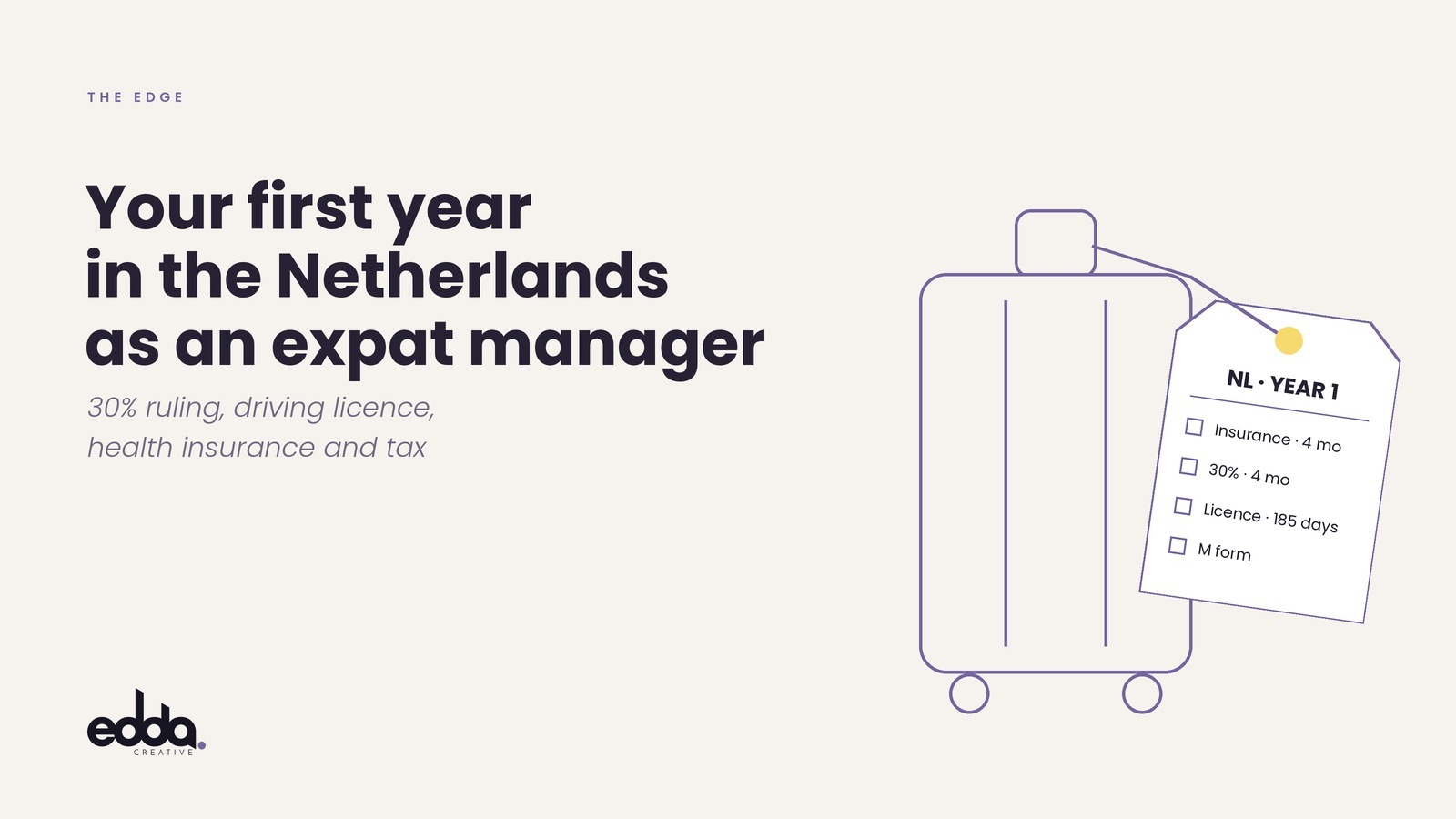
Moving to the Netherlands as a manager means your first months are as much about paperwork as about the job. Some of that paperwork has a deadline: miss it and you either lose a benefit you cannot get back or you have to take the longer route. We brought together the six things that newly arrived managers and their families most often miss in their first Dutch year, each checked against official sources.
This article is general information, not tax or legal advice. For your own situation, rely on the Belastingdienst (Dutch Tax Administration) or a tax adviser. Information checked on official websites on 10 November 2026.
At a glance: the first-year deadlines
| Topic | Deadline | If you miss it |
|---|---|---|
| Health insurance | Within 4 months of arrival | No retroactive cover, possible fine |
| 30% ruling (expat scheme) | Apply within 4 months of starting work | May not apply from your first working day |
| Non-EU driving licence | 185 days after moving | Dutch driving test required |
| Switching health insurer | 31 December every year | Locked into next year’s premium |
| Tax return for your arrival year | M form, online for the last 5 years | Missed chance to reclaim overpaid tax |
1. Health insurance: within 4 months, not backdated
Everyone who comes to live or work in the Netherlands must take out Dutch basic health insurance (basisverzekering). According to the Dutch government, you should do this as quickly as possible and no later than 4 months after arrival. Cover is not backdated: if you are late, care you received in the meantime is not reimbursed and you may be fined (Government.nl). You also need to register with your municipality.
The compulsory deductible (eigen risico) is €385 in both 2026 and 2027, and your insurer can let you pay it in instalments (Rijksoverheid). New premiums are announced every November. If you take out a new policy by 31 December, your new insurer cancels the old one for you (Rijksoverheid). If you moved with your family, check the policy for each family member separately.
2. The 30% ruling: apply with your employer in the first 4 months
The Netherlands allows employers to pay part of the salary of certain incoming employees tax-free. The scheme is now officially called the expat scheme (expatregeling) and is widely known as the 30% ruling. According to the Belastingdienst, the main conditions in 2026 are (Belastingdienst):
- You lived more than 150 km as the crow flies from the Dutch border for more than 16 of the 24 months before your first Dutch working day.
- Your annual salary (excluding the tax-free part) is above €48,013. If you are under 30 and hold a master’s degree, the threshold is €36,497.
- You apply together with your employer. If you apply within 4 months of starting with a new employer, the scheme can apply from your first working day.
- It runs for up to 5 years, reduced by any earlier work or residence in the Netherlands.
The rate changes from 2027. According to the Dutch government, the tax-free part stays at a maximum of 30% in 2025 and 2026, then drops to a maximum of 27% from 2027 with a higher salary threshold. From 1 January 2026 the calculation is capped at a salary of €262,000 (Rijksoverheid). Transitional rules depend on when you started, so check them with your employer’s payroll team (Ondernemersplein).
3. A non-EU driving licence: 185 days, then exchange only with an expat decision
With a driving licence from outside the EU, you can keep driving for 185 days after you move to the Netherlands. After that, you may only drive in the Netherlands with a Dutch licence (RDW).
Only licences from a short list of countries can be exchanged as standard (for example Japan, South Korea, Singapore, Israel and the UK). According to the RDW, there is an important exception: with a valid expat scheme decision (beschikking) from the Belastingdienst, a licence from any country can be exchanged, and the same applies to a partner and children living at the same address. Without it, you have to pass the CBR theory and practical tests (RDW). In other words, exchanging your licence while you hold the 30% decision can save months of driving lessons and exams.
4. The tax return for your arrival year: the M form
The income tax return for the year you moved to the Netherlands can only be filed with the M form (M-formulier) (Nederland Wereldwijd), and you can file it online through Mijn Belastingdienst (Belastingdienst). According to Nederland Wereldwijd, the M return can usually be filed online for the last 5 years.
If you worked in the Netherlands for only part of the year, the tax withheld through payroll may be higher than what you owe for the year. So do not skip the first-year return: you can see the result before you submit.
5. Families with children: child benefit and childcare allowance
Families living in the Netherlands with children can receive child benefit (kinderbijslag) from the SVB every quarter. The amount goes up when a child turns 6 and again at 12 (SVB).
If your child goes to registered daycare or out-of-school care, you can apply for childcare allowance (kinderopvangtoeslag). In 2026 it is calculated on a maximum hourly rate of €11.23 for daycare, €9.98 for out-of-school care and €8.49 for childminders. The percentage depends on income: 96% for families with a combined income up to about €56,000, falling to 36.5% for the first child and 68.2% for further children at high incomes. The months worked by the parent who works least are used in the calculation (Rijksoverheid). Even on a manager’s salary, the support from the second child onwards is significant.
6. Setting up your own company? Keep personal and company paperwork apart
If you are coming to the Netherlands to set up a company, the company has its own calendar alongside the personal steps above: Chamber of Commerce (KvK) registration, address, bank account, VAT and bookkeeping. We set out the order in our article on the first 90 days after KvK registration and what to look for in a company formation adviser.
At Edda Creative, our company formation service in the Netherlands organises the notary, KvK, address, bank, accounting and legal steps, followed by 6 months of advice, interpreting and follow-up after formation. For your personal tax return or 30% ruling application, we recommend working with your employer’s payroll team or a tax adviser. Preparing for your first meetings with Dutch partners? Our guide to doing business with Dutch companies may help.
Update (14 November 2026): For registering with a GP, referrals, out-of-hours care and the €385 deductible, see our guide to Dutch healthcare for expats.
Frequently asked questions
How soon do I need Dutch health insurance after moving?
No later than 4 months after you arrive. Cover is not backdated, so care in the meantime is not reimbursed and you may be fined.
What is the salary threshold for the 30% ruling in 2026?
According to the Belastingdienst, your annual salary must be above €48,013 in 2026, or €36,497 if you are under 30 and hold a master’s degree. From 2027 the rate drops to 27% and a higher threshold applies.
Can I exchange my non-EU driving licence for a Dutch one?
Only if your country is on the RDW’s list, or if you hold a valid expat scheme decision from the Belastingdienst; that also covers a partner and children at the same address. Otherwise you need to pass the CBR tests. You can drive on your foreign licence for 185 days after moving.
How do I file my tax return for the year I moved?
The return for your arrival year can only be filed with the M form, online through Mijn Belastingdienst. Online M returns are usually possible for the last 5 years.
Does Edda Creative file my tax return?
No. We organise company formation in the Netherlands and the first 6 months of follow-up. For your personal tax return and 30% ruling application, we recommend your employer’s payroll team or a tax adviser.
Sources (checked on 10 November 2026): Belastingdienst: Expat Scheme · Rijksoverheid: tax benefit for foreign employees (Dutch) · Ondernemersplein: 30% to 27% (Dutch) · RDW: driving with a foreign licence (Dutch) · RDW: exchanging a foreign licence (Dutch) · Government.nl: health insurance · Rijksoverheid: eigen risico (Dutch) · Rijksoverheid: switching insurer (Dutch) · Belastingdienst: M return (Dutch) · Nederland Wereldwijd (Dutch) · Rijksoverheid: childcare allowance 2026 (Dutch) · SVB: child benefit