9 min read
The EU Industrial Accelerator Act and ‘Made in EU’: what it means for manufacturers, suppliers and buyers
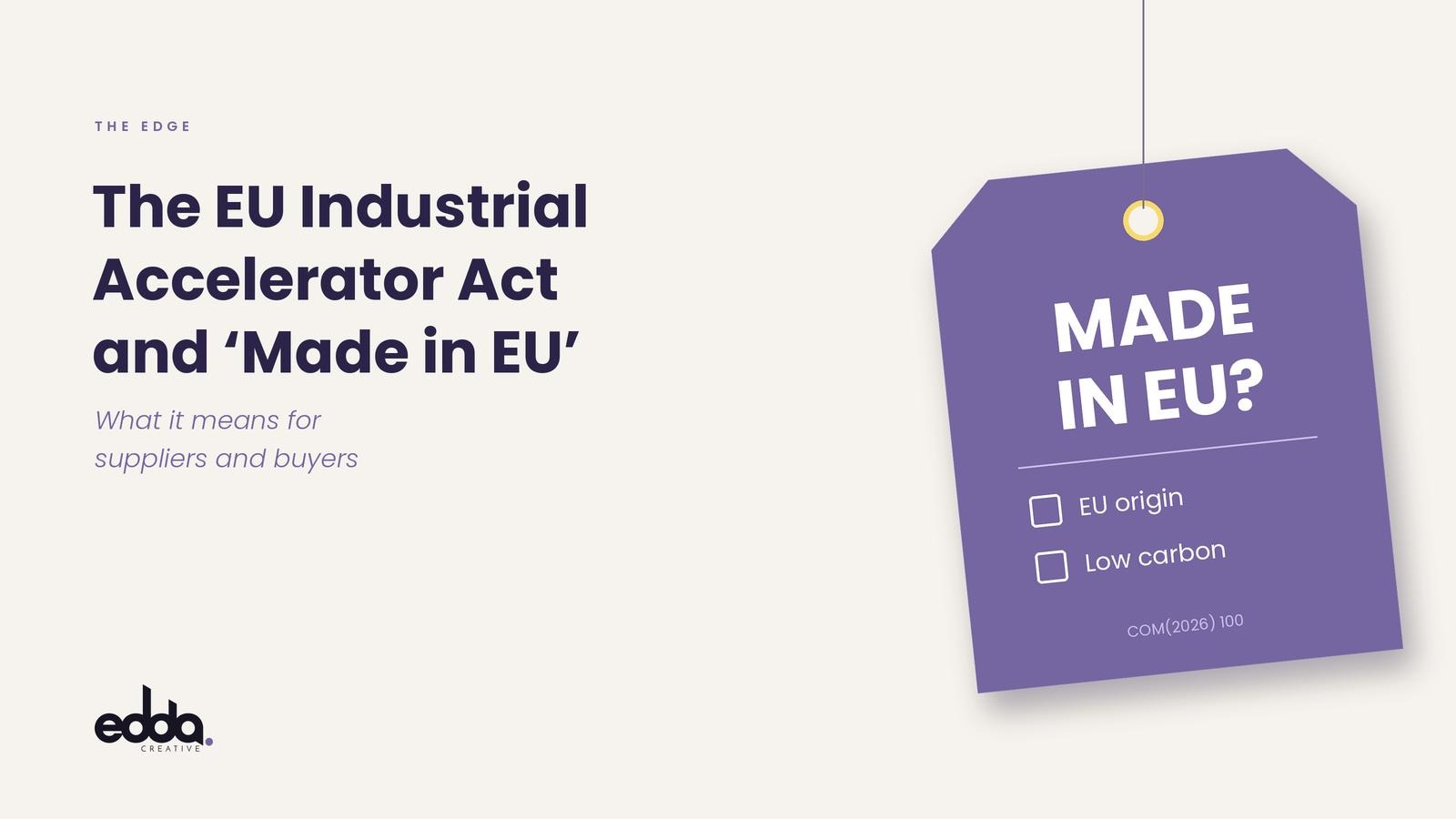
The European Union is preparing to turn a ‘Made in EU’ preference into law. The Industrial Accelerator Act (IAA), proposed by the European Commission on 4 March 2026, would add EU-origin and/or low-carbon requirements to public procurement and publicly funded support schemes for selected products, from steel and cement to vehicles, batteries and solar panels.
The rules would matter well beyond Europe’s borders. EU manufacturers could gain a preferred position, public buyers would have new requirements to apply, and suppliers from Asia, the Americas, the UK, Türkiye and elsewhere need to know whether their content would count as ‘EU origin’. Under the Commission’s draft, that depends on the trade agreement each country has with the EU, and that is exactly what the European Parliament and the Council are now debating. This guide sets out what the draft says, who is affected, how partner countries are treated, where negotiations stand and what companies can do now.
In short: what is the Industrial Accelerator Act?
- Goal: raise manufacturing’s share of EU GDP from 14.3% in 2024 to 20% by 2035.
- Tools: EU-origin and/or low-carbon requirements in public procurement and public support schemes; conditions on large foreign investments in clean-tech sectors; faster permitting for industrial projects.
- Products covered: steel (low-carbon requirements), cement, concrete and mortar, aluminium, vehicles and batteries, and net-zero technologies such as solar, wind and heat pumps.
- Vehicles: under the draft, a vehicle counts as EU origin if at least 70% of the ex-works value of its components (excluding the battery) originates in the EU, or if at least three main battery components, including the cells, originate in the EU.
- Share of subsidies: Member States would apply the requirements to at least 45% of the budget of national support schemes covering energy-intensive products, and to 100% of the budget of schemes covering vehicles.
- Foreign investment: investments of at least €100 million by companies from countries holding more than 40% of global manufacturing capacity in batteries, electric vehicles, solar or critical raw materials would face conditions, including employing at least 50% EU workers.
- Timing: the proposal is for a regulation; if adopted, it would apply one year after entry into force.
Origin would be determined under the EU’s non-preferential rules of origin. What counts is where and how a product is made, not simply whether it circulates freely within a customs union (proposal text, EUR-Lex).
Who is affected?
- Manufacturers in the EU: EU-made or low-carbon products in the covered groups, from steel and concrete to vehicles and clean tech, would gain a preferred position in covered tenders and subsidies, provided origin and carbon performance can be documented.
- Public buyers: contracting authorities would have to apply origin and/or low-carbon requirements, depending on the product group, for example in construction and infrastructure tenders or when buying buses and other vehicles.
- Suppliers outside the EU: whether their content counts as EU origin depends on their country’s trade agreement with the EU, as explained below.
- Investors: large investments in batteries, electric vehicles, solar or critical raw materials by companies from countries with a dominant global position would face conditions, which could shape joint ventures and plant plans in Europe.
Who counts as ‘EU origin’? The partner-country question
- Article 8 (public procurement): content from countries with an EU free trade agreement or customs union, or that are parties to the WTO Government Procurement Agreement (GPA), is deemed EU origin, where the EU has relevant obligations under that agreement.
- Article 9 (support schemes): content from free trade or customs union partners is deemed EU origin; GPA membership alone does not count.
- Exclusions: the Commission could exclude countries, wholly or partly, through delegated acts, for example if they fail to give EU products national treatment or if exclusion is needed for security of supply.
In practice, according to the European Parliament’s research service, China would fall outside both articles, and the US could benefit in procurement as a GPA party but not in support schemes. Partners such as the UK, which is both a GPA party and an FTA partner, would generally qualify under the draft. Commission Executive Vice-President Stéphane Séjourné reportedly said the equivalence clause would apply to only around 20 countries (EPRS).
Türkiye is a special case. Under Article 9, its customs union with the EU brings Turkish content into the draft’s definition of EU origin for support schemes. For public procurement, Article 8 applies only where the EU has relevant obligations under the agreement, and the customs union does not cover public procurement; Türkiye is not a GPA party either. Article 11 of the draft would exclude, from covered tenders, bids by companies owned or controlled by entities established in countries without an agreement with the EU guaranteeing access to these tenders. So Turkish components could count as EU origin inside a European manufacturer’s product, at least in support schemes, while Turkish companies bidding directly for covered tenders could still be restricted.
Where negotiations stand
- European Parliament: the file is handled jointly by the ITRE, IMCO and INTA committees. The rapporteurs’ draft report of September proposes an ‘opt-in’ model, under which trade agreements alone would not make a country equivalent; partners would have to be admitted through delegated acts, subject to conditions such as national treatment, economic security and ratified and effectively implemented fundamental ILO conventions. The joint committee vote is scheduled for 1 December and the plenary vote, still to be confirmed, for the week of 14 December (European Parliament; EPRS).
- Council of the EU: a Presidency compromise discussed in September would replace the broad ‘Made in Europe’ concept with a system based on trade agreements and product-specific market access. The Council has not yet agreed its position.
- Member States: according to press reports, France and Germany reached a non-binding preliminary agreement in October on the act’s geographic scope that would exclude Türkiye while leaving room for the UK and EFTA countries. The European Automobile Manufacturers’ Association (ACEA) has called for targeted exemptions for European manufacturers operating in neighbouring countries with close industrial ties, such as Türkiye (Türkiye Today).
- Türkiye: Turkish Trade Minister Ömer Bolat has called for the new EU industrial policies to remain compatible with the customs union (Turkish Ministry of Trade, in Turkish).
The stakes are high on both sides. According to the Turkish trade minister, EU–Türkiye trade reached USD 233 billion last year, with automotive accounting for around 26% (USD 62 billion); EU companies account for around 75% of Türkiye’s automotive production (Bloomberg HT, in Turkish). Once Parliament and Council have adopted their positions, trilogue negotiations between Parliament, Council and Commission can begin.
What companies can do now
The final text is not settled, but companies that prepare now will be better placed whichever scenario wins.
- Map your origin: which of your products fall into the covered groups, where do components and materials come from, and where is the product made under non-preferential rules of origin? For vehicle and parts makers, the 70% threshold is a concrete benchmark.
- Know your customer’s customer: do your European buyers sell to municipalities, public transport operators, infrastructure projects or subsidised programmes? That is where the impact will be felt first.
- Talk to your buyers now: they face the same uncertainty. Showing that you can provide origin and carbon data builds trust.
- Get your carbon data ready: low-carbon requirements matter regardless of origin. Product carbon footprints and environmental product declarations are increasingly expected, alongside the EU’s Carbon Border Adjustment Mechanism (CBAM).
- Rebuild your message: tell European buyers about proximity, delivery security, your position in their supply chains and your track record with EU partners, not only price. Back the ‘trusted partner’ claim with evidence.
- Follow the process: the December votes and the trilogues that follow will decide the geographic scope. Keep in touch with your industry association and get legal and customs advice on the details.
How Edda Creative helps
With our team in Amsterdam and Ankara, we work with manufacturers operating between Türkiye, the Netherlands and the wider European market on strategy, branding and communication. In the ‘Made in EU’ debate, the way suppliers present themselves to European buyers matters more than ever: reliability, traceability and carbon data are now part of the marketing message.
We sharpen your positioning and message for European markets, and produce presentations, catalogues, web pages and LinkedIn content for your buyers in English, Dutch and Turkish. Customs, origin and legal assessments are not our field, so we recommend working with your own advisers on those. Sales and customer relationships stay with your team; we focus on making sure your brand is understood the right way in Europe. Planning trade fairs? See our 2027 Netherlands trade fair calendar and our EIF 2026 guide.
If you would like to talk about your message for European buyers, you can email us at info@eddacreative.com with a short description of your project.
Frequently asked questions
Is the Industrial Accelerator Act in force?
No. The European Commission proposed it on 4 March 2026, and it is being negotiated in the European Parliament and the Council. Under the proposal, it would apply one year after entry into force.
Which countries count as ‘EU origin’ under the draft?
Under the Commission’s draft, content from free trade or customs union partners counts as EU origin for support schemes, and GPA parties are added for public procurement, subject to conditions. The Parliament’s draft report and the Council’s discussions could narrow this scope.
Does the act ban non-EU products from the EU market?
No. The origin and low-carbon requirements apply only to public procurement and publicly funded support schemes for specific products. Private sales without public support are not covered.
Which sectors are affected?
Steel, cement, concrete and mortar, aluminium, vehicles and batteries, and net-zero technologies such as solar and wind.
When does a vehicle count as EU origin?
Under the draft, at least 70% of the value of its components, excluding the battery, must originate in the EU, or at least three main battery components, including the cells, must originate in the EU.
Based on the European Commission’s proposal, European Parliament documents and official statements as of 29 October 2026. This is not legal advice. Negotiations are ongoing and the final text may differ.
Sources
- EUR-Lex – Industrial Accelerator Act proposal, COM(2026) 100
- European Commission – announcement of 4 March 2026
- European Parliament – Legislative Train: Industrial Accelerator Act
- EPRS – International dimension of the proposed Industrial Accelerator Act (September 2026)
- Turkish Ministry of Trade – Minister Bolat in Brussels (29 September 2026, in Turkish)
- Bloomberg HT – Minister Bolat on the customs union (13 October 2026, in Turkish)
- Türkiye Today – ACEA and OSD on the ‘Made in Europe’ rules (26 October 2026)