5 min read
Outsourcing marketing to an agency outside the EU: how the VAT reverse charge works
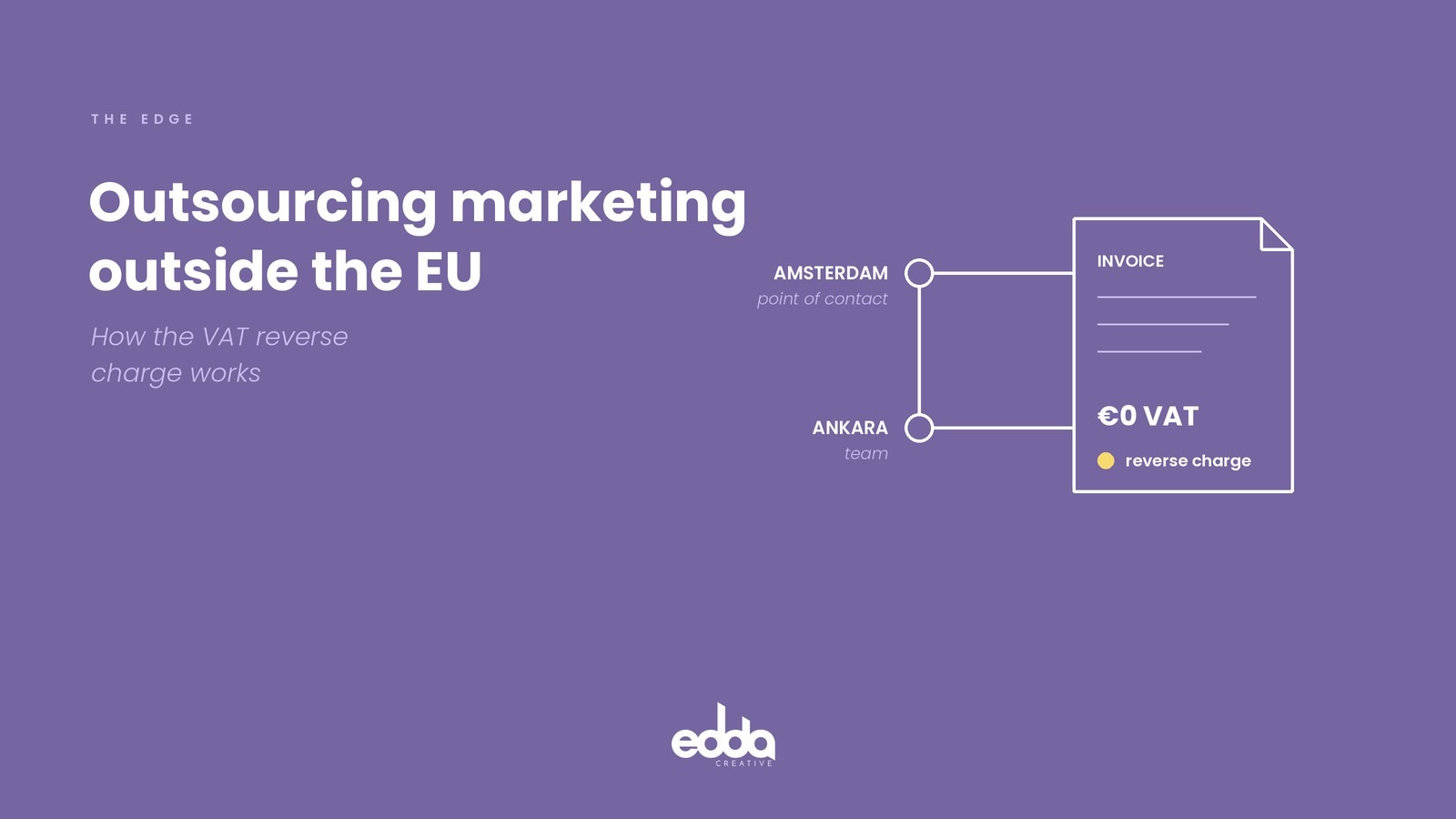
When an EU business outsources social media, content, video or campaigns to an agency outside the EU, the invoice usually carries no VAT. Under the reverse charge, the business itself accounts for the VAT in its own return and, if it can recover VAT, deducts the same amount in that return.
This article explains how that works, what it means for cash flow, when it is not an advantage and what else to check when working with an agency outside the EU. It is general information, not tax advice: check your own situation with your tax authority or accountant.
The short answer
- Place of supply: under the EU VAT Directive, business-to-business services are generally taxed where the customer is established (Directive 2006/112/EC, Articles 44 and 196). For a business in the Netherlands, Germany or France, that means VAT in its own country.
- Reverse charge: where the supplier is not established in that country, the customer is liable for the VAT. The invoice is issued without VAT and states ‘Reverse charge’.
- Return: the customer reports the VAT in its own VAT return.
- Deduction: if the customer has the right to deduct input VAT, it deducts the same amount in the same return, so the net amount is usually zero.
- Exceptions: some services, such as those connected with immovable property or admission to events (for example trade fair tickets), follow different rules, and national practice varies. Marketing, social media, content, design and consultancy usually fall under the general rule.
A worked example: social media at €3,000 a month
Take a VAT-registered company in the Netherlands with a full right to deduct, outsourcing social media and LinkedIn content for €3,000 a month (excluding VAT), at the Dutch standard VAT rate of 21%.
- Local agency: the invoice is €3,630 (€3,000 + 21% VAT). The company pays it and deducts the €630 as input VAT in the return for the period in which it received the invoice. Until that return is settled, the €630 is tied up: a few weeks for monthly filers, up to a few months for quarterly filers, depending on payment terms.
- Agency outside the EU, reverse charge: the invoice is €3,000 without VAT. In its return the company reports €630 VAT and deducts €630. It pays €3,000 and does not pre-finance any VAT.
The VAT itself nets to zero in both cases. The difference is cash flow, not cost. Any real price difference comes from the agency’s rates, not from VAT.
When is it not an advantage?
- VAT-exempt activities: organisations in healthcare, education or financial services, and small businesses using a VAT exemption scheme, often have no or limited right to deduct. The reverse-charged VAT is then a real cost, just like VAT on a local agency’s invoice.
- Not a business: the reverse charge applies to supplies to businesses. The agency will normally ask for your VAT identification number as evidence of business status; for private individuals and non-business organisations, other rules apply.
- Other countries, other rules: if your business is established outside the EU, for example in the UK, similar reverse-charge rules apply, but details differ. Check the rules where your business is established.
What the agency needs from you
- Your company’s legal name and address.
- Your VAT identification number, which appears on the invoice together with the reverse-charge note.
- Clear invoicing terms: monthly, per project or per campaign, and in which currency.
What else to check with an agency outside the EU
- A local point of contact: briefings, planning and feedback go faster in your own language and time zone.
- Time difference: plan fixed meeting slots. Türkiye, for example, stays on UTC+3 all year, so the gap with Central Europe is 2 hours in winter and 1 hour in summer (see our article on winter time).
- Personal data (GDPR): if the agency processes personal data, such as customer lists or direct messages, you need appropriate safeguards. Only a limited number of countries have an EU adequacy decision; Türkiye is not one of them (European Commission). Put this in writing: a data processing agreement and, for the transfer, safeguards such as the European Commission’s standard contractual clauses.
- Rights to content: agree in writing that the rights to designs, copy, photos and videos, including source files, are transferred to you once paid for.
- Reporting: monthly reporting with consistent KPIs, so you can compare results over time.
How Edda Creative works
Edda Creative works with teams in Amsterdam and Ankara. Clients have a fixed point of contact in the Netherlands, while strategy, content production, design and video are handled by our team in Ankara. We invoice from Türkiye, so business clients in the EU receive invoices without VAT under the reverse charge. Read more on our social media outsourcing page and in what social media management costs.
Want to see whether it fits your company? Email us at info@eddacreative.com with a short description of your project.
Frequently asked questions
Do I pay VAT if an agency outside the EU runs my social media?
Usually you account for the VAT yourself under the reverse charge and, if you can deduct input VAT, deduct it in the same return. The net amount is then zero.
Is an invoice without VAT valid?
Yes, when the reverse charge applies. The invoice should state ‘Reverse charge’ and include your VAT identification number.
Is it cheaper than a local agency?
Not because of VAT, which nets to zero if you can deduct it. You do avoid pre-financing VAT. Any price difference comes from the agency’s rates.
Does this apply to VAT-exempt organisations?
The reverse charge still applies, but without the right to deduct, the VAT becomes a cost, so the advantage of an invoice without VAT disappears.
General information as of 29 October 2026. This is not tax or legal advice; check your situation with your tax authority or accountant.
Sources
- EUR-Lex – VAT Directive 2006/112/EC
- Ondernemersplein (Dutch government) – Importing services from outside the EU (Dutch)
- Belastingdienst – VAT on services (Dutch)
- GOV.UK – VAT place of supply of services (Notice 741A)
- European Commission – Adequacy decisions